The Tyranny of Things

Richard Collins, Abbot

(Kusen: Sunday, 26 March 2026, New Orleans Zen Temple)

Since March I have been steadily writing my book about Robert’s life and legacy. It is largely now sketched out. Several chapters, though, have been hard to write, especially the late chapters, which deal with the dismantling of Camp Street and Robert’s death.

While writing about these difficult subjects, the phrase “the tyranny of things” occurred to me. Things have great power over us, or rather we allow things to have great power over us. When referring to the temple on Camp Street, it is not just the building but also its contents. And not just those things that are the repositories of our personal memory, but also the archives, letters, documents, receipts, and so on, things that tell the story of an era, a life.

The phrase “the tyranny of things” is not original with me. It is a universal phenomenon and has been articulated in many ways over the centuries, at least as long as people had stories to tell, memories to draw from, and things to possess that related to those memories, both pleasant and unpleasant.

A couple of essays with that title appeared as early as 1893 and 1917.[1] But of course, monks of all sorts, Daoist and Zen and Christian, have examined the idea long before that. Monks are home-leavers, mistrustful of possessions, things that tie them down to this world and its heavy burden of responsibilities.

For those of us who can’t cast off these responsibilities so easily, we continue to be entangled in the world of things. Trapped, like Monkey from the great Chinese folk novel, The Journey to the West. Sun Wukong, whose name means Monkey Awakened to Emptiness, isentombed in the side of a mountain before he is released to accompany the Buddhist monk Xuanzang on his trip to the Buddhaland to retrieve the Tripitaka, the three baskets of Mahayana teachings, including the Heart Sutra, with its essential message of emptiness.[2]

I am reminded of the opening of Henry Miller’s novel Tropic of Cancer. The narrator declares: “I have no money, no resources, no hopes. I am the happiest man alive.” It is not just monks who feel the freedom of nothing left to lose.

When we come to zazen, we experience the nonattachment of not being enslaved by things. The rest of the time our possessions own us far more than we own them.

Robert began to detach from things long before he was detached from life itself. Until he discovered Zen, or Zen discovered him, when he was living on hedonistic Capri, he was awash in the world of samsara, living the high life in Europe. Thus the first half of his life was all about experiencing things, if not acquiring them; the second half was all about casting them off. But life itself, this mortal coil, is the last of those things to be cast off, and not easily. As he used to tell us, don’t worry about nirvana, you will reach it soon enough. Nirvana: the ultimate nonattachment.

The book I am writing, which I am calling a “biographical memoir,” is Robert’s biography but also my memoir of my time with him. It is called Great Abandonment. Robert’s life was a series of abandonments: being abandoned by others like his parents, and abandoning people and places, wives and children, places and things. My life has been similar in that way. So was the Buddha’s. So are all our lives, whether we know it or not.

And yet complete abandonment is impossible because we are all beset by the tyranny of things.

This week I am in the process of dealing with a situation that is similar to the closing years of Robert’s life. A relative is in memory care and I have been helping to dispose of their things, the physical objects of memory, the souvenirs, the detritus of a life lived for over eighty years.

This is a process that all of us and our things will undergo in some way or another. Whether we die suddenly, when others will have to dispose of our things. Or whether there is a slower and more painful process of detachment.

Zazen allows us to face this reality, even as we remain entangled in it.

On the drive here from Tennessee my wife read to me a book called Altered Traits,[3] an overview of the science of the effects of meditation. This morning she cited an experiment in which longtime Zen practitioners were proven to have a significantly increased endurance to pain.

Anyone who has sat in sesshin with the karma of their knees and back knows this. Anyone who sat with Robert and heard his kyosaku-like “Don’t move!” might think that he did not want to be disturbed by your fidgeting; but really he was saying, “Endure!” Learn how to endure the discomfort and learn from the endurance that the pain is just your reaction and interpretation of that discomfort.

But the scientists determined something of greater interest. This increased ability to endure pain was not just a result of the “altered state” during zazen, but it became an “altered trait” thanks to long-term practice.

This is what short-term practitioners do not appreciate. It takes time for the lessons of our bodies and minds to set in. Those who look for short-term results are also those who continue to experience discomfort as pain, responsibilities as impositions, and reality as a personal affront.

When we come to zazen, we climb into our coffins, where pain is just a thing of the living. When we leave zazen we climb out of our coffin, and we realize that living is the field of our practice. We return to our discomfort, our responsibilities, and our reality but with a new equanimity, where our awakening to emptiness allows us to see that poverty, the absence of things and the absence of hope, become the field of our freedom.

___

[1] These two essays, by Elizabeth Morris and by Edward Sanford Martin, can be accessed online in Quotidiana: https://essays.quotidiana.org/.

[2] There are many translations, mostly abridged versions, of this classic, including those by Arthur Waley and Anthony C. Yu, but the best and most complete version is that by W. J. F, Jenner published by Foreign Language Press in Beijing.

[3] Daniel Goleman and Richard J. Davidson. Altered Traits: Science Reveals How Meditation Changes Your MInd, Brain, and Body (New York: Avery, 2018).

STINK OF ZEN, POISON DRAGONS: Making Wang Wei’s Poem My Own

Richard Collins, Abbot

In the summer 2026 issue Tricycle published my poem “In the Posture of the Water Dragon” after a poem by Wang Wei from my collection Stone Nest (Shanti Arts Publishing, 2025).

Every translator makes a poet their own, of course, more or less unconsciously. But I do not know Chinese and do not presume to be a translator. Mine is an “after” poem that echoes the original and engages in conversation with the poet across the distances of time, space, culture, and personal awareness.  

All of the poems of Stone Nest are to some extent “in conversation with” the ancient Chinese poets. Another poem begins: “Here on the mountain we may not be closer to God / but we’re closer to the ancient Chinese poets / who chose to be closer to nature and themselves.”

Some of these poems began as loose translations or “versions” of the original poems, usually following literal translations that lack articles, tenses, plurals, and even person or point of view. Many of my “versions” did not make it into the book, being closer to being translations than responses. All of the poems in the book are in the spirit of the Chinese poets.

When I used to teach world literature I would have students compare several translations along with a literal translation to “triangulate” the many possibilities a translator has to work with in English.

Here is a translation of Wang Wei’s poem by Burton Watson, one of the more prolific translators of Chinese poetry. (The Columbia Book of Chinese Poetry, translated and edited by Burton Watson. New York: Columbia UP, 1984, p. 202-03.)

VISITING THE TEMPLE OF ACCUMULATED FRAGRANCE

I didn’t know where the temple was,
pushing mile on mile among cloudy peaks;
old trees, peopleless paths,
deep mountains, somewhere a bell.
Brook voices choke over craggy boulders,
sun rays turn cold in the green pines.
At dusk in the bend of a deserted pond,
a monk in meditation, taming poison dragons. 

This seems very straightforward, but certain choices have been to pin down what was in the original Chinese ambiguous. 

Even the title makes a choice that is not clear in the original. Sometimes called “Stopping at Incense Storing Temple” it is not clear whether the narrator actually finds the Temple or is simply looking for it. Do they actually “visit” or “stop” at the temple or do they “pass by” it and sense its presence by its strong fragrance? 

One literal translation of the poem (http://www.chinese-poems.com/incense.html) looks like this: 

STOPPING AT INCENSE STORING TEMPLE

not know incense store temple
few li enter cloud peaks
ancient trees no person path
deep hills what place bell
spring sound choke sheer rock
sun colour cold green pines
dusk empty pool bend
peace meditation control fierce dragon 

Even a so-called literal translation, however, can show great variation.

Wai-Lim Yip’s literal version is more precise in recognizing the ambiguity of connotation in certain words and phrases. (See Wai-Lim Yip, Chinese Poetry: An Anthology of Major Modes and Genres. Durham, NC: Duke UP, 1997, p. 189.) Where the smell of incense has been “accumulated” or “stored” or “piled up” or “heaped” in other versions, in Yip’s version it “teems.” (“Stored” makes it sound as though the temple warehouses its stock of incense there, instead of the sensory accuracy of smelling a place that has been infused with the odor of incense burned over the course of many years.) The sound of the “pond” or “pool” in other versions becomes a “fountain” or “spring” in Yip’s. Where the pool “chokes” in other versions, in Yip’s it also “sobs” or “swallows.” Where others see a “craggy” or “sheer” rock, Yip’s becomes “perilous.” And what others call “peace meditation” that “tames” or “controls” a “poison” or “fierce” dragon becomes for Yip the more literal “pacifying Ch’an or Zen” that “exorcises” a “poisonous” dragon (that he upgrades to a “virulent dragon” in his final version).

The result is what seems to me to be the clearest “translation” of Wang Wei’s poem:

PASSING THE TEMPLE OF TEEMING FRAGRANCE

Where is the Temple of Teeming Fragrance?
Miles and miles into cloud-peaks.
Ancient trees; no man’s path.
Deep in the mountains: where, this bell?
Fountain sobs, swallowing perilous rocks.
Sun’s color chills green pines.
Dusk. At an empty pool’s bend,
Meditation exorcises heart’s virulent dragon. 

I wish he had retained “Ch’an” or “Zen” for 禅 in place of a mere generic “meditation.” And “exorcising” the “virulent” dragon seems to be exalting the dragon into the status of a demon and its poison into an infectious disease in a somewhat melodramatic final flourish. But otherwise Yip’s choices seem justified and well-informed, and his mostly five-word lines echo nicely the five-character lines of the original, while not trying to smooth out the staccato images into colloquial English.

My own version, in conversation with Wang Wei’s poem, changes the meaning while inflecting it with my own experience while living on the 22 acres of the Zen hermitage called Stone Nest in Sewanee, Tennessee.

IN THE POSTURE OF THE WATER DRAGON

After Wang Wei 

To avoid the stink of incense at the temple,
I wander a few miles along a foggy trail.
No one anywhere on the ancient path between the trees.
A bell rings deep in a dark ravine,
a spring gurgles down a steep rock gulley.
Bright chestnuts chill the prism of slanting light.
At dusk I sit by the calm deserted pool
in the posture of the water dragon. 

In all these versions we see a similar core experience of the juxtaposition of an absent but fragrant temple (searched for, missed, or left behind) and a present fountain, spring, or source (where the struggle for enlightenment or awareness is conducted in the solitude of nature).

Still, I think you can see Wang Wei’s point and, in contrast, mine. Two things stand out at the beginning and end. First, in the opening line, the attitude toward the fragrance of the “incense accumulating temple” in the other versions is different from the temple’s “stink” in mine. Then, in the closing line, the toxic dragon that meditation is supposed to exorcise becomes simply the water dragon, or myself, that Zen reveals in the reflection of the pool.

In Watson’s version there is an unidentified “monk in meditation, taming poison dragons.” In my version, I take “the posture of the water dragon.” The posture I am taking is not that of some spiritual dragon-slayer but my own (born in 1952, I am a Water Dragon in the Chinese zodiac). In Zen practice, as opposed to generic meditation, poison dragons stand for the bonno (illusions or delusions that come from the three poisons of anger, greed, and ignorance). Watson’s monk tames the poison dragons within to become human again, alluding to the myth. (Watson’s footnote explains: “The poison dragons are passions and illusions that impede enlightenment. They also recall the tale of a poison dragon that lived in a lake and killed passing merchants until it was subdued by a certain Prince P’an-t’o through the use of spells. The dragon changed into a man and apologized for its evil ways.”) By taking the posture of the water dragon, however, I am simply becoming myself, dropping off body and mind to become my true self, the one Kodo Sawaki says is the one we have not thought of.

The point is, to return to the beginning of the poem, in order to become our true self we must leave the “stink” of the incense-accumulating Zen temple behind. Not literally perhaps, and not forever, because we can always return to the ritual and the forms; but to really become ourselves we have to leave all temples and all religions behind, return to the natural state, our own nature which is empty, and like the fountain, the source, far from the stink of Zen.

That path is long and foggy, but it is an ancient path, and when we reach the source, we can drop the poses and become ourselves in our own posture. The ritual and forms of the temple are fine, but zazen is the key. Zazen does not need a formal ritual space but only a space at the source of one’s own nature. A temple is like a gym or training ground for the warrior within; it is not where the battle takes place, which is within oneself.

In my own experience, I left the New Orleans Zen Temple twice. First, I left for five years (2005-2010) to do battle on my own. I did not leave the practice of zazen, of course, but set up dojos where I found myself (in Alexandria LA and Bakersfield CA) when I was asked to. When I returned, my teacher didn’t punish me for leaving, he asked me to take monastic ordination and to take over the temple for him.

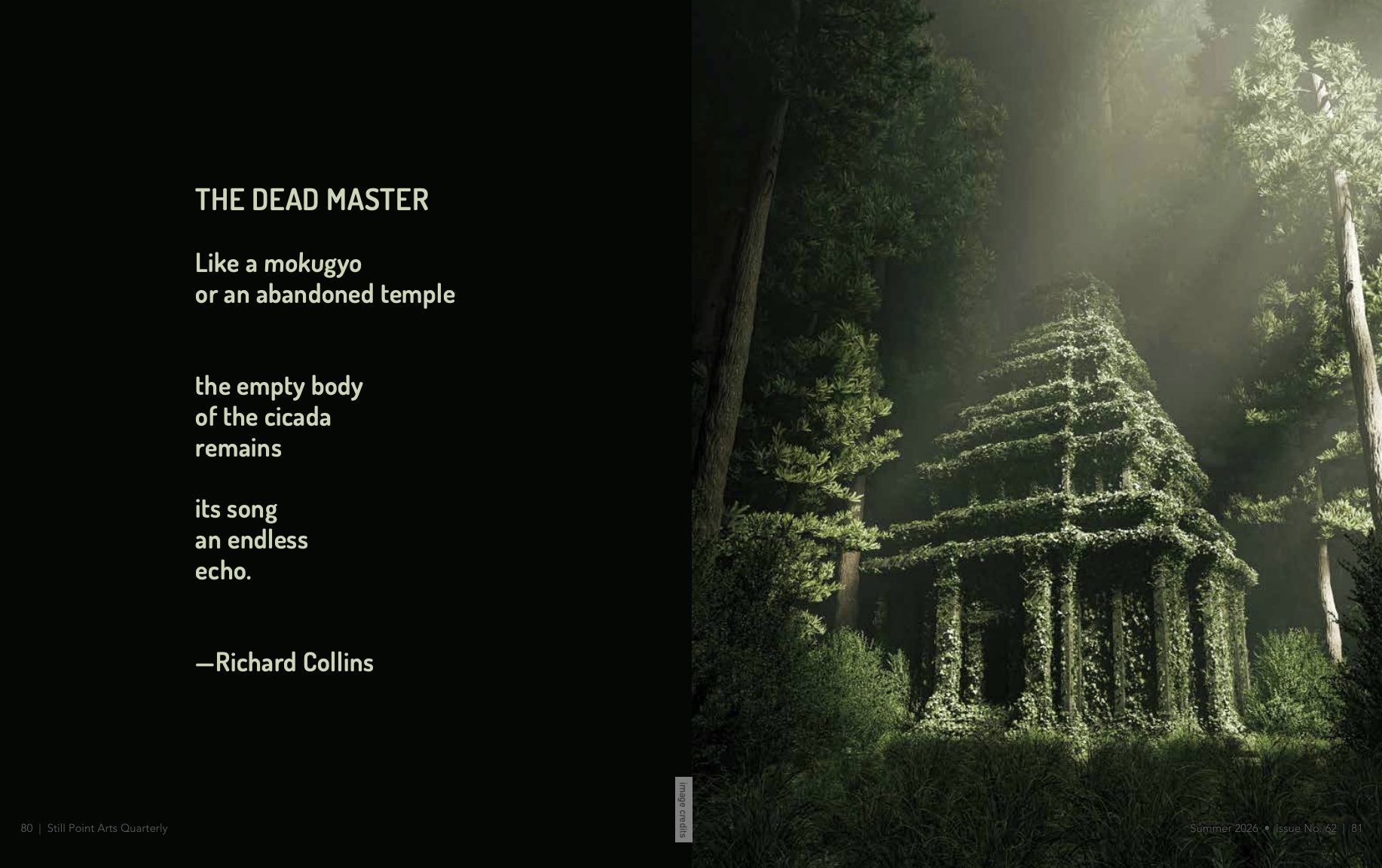
The second time I left the temple of accumulated fragrance behind was when the building on Camp Street was sold and the Temple dismantled. This time I left it behind the way a cicada leaves its exoskeleton. (In “The Dead Master,” published in Still Point Arts Quarterly, I compare the Temple to Robert’s exoskeleton, and him in old age to the Greek figure Tithonus, who asked the gods for eternal life but forgot to ask for eternal youth, and therefore was doomed to wither away and chatter for eternity in the form of a cicada.) The true temple, however, like the cicada, is not to be found in buildings or empty exoskeletons but in the living body that takes on new incarnations.

THE DEAD MASTER

Like a mokugyo
or an abandoned
temple 

the empty body
of the cicada
remains 

its song
an endless
echo. 

The new battles with poison dragons continue to occur at Stone Nest. Not with the forms or fragrances, not with external pressures and temptations, but with myself.

Courtesy of Still Point Arts Quarterly.

OF DREAMS, DELUSIONS AND DEATH DOULAS

Deshimaru was not a fan of dreams or dream interpretations. He considered dreams to be more delusion piled upon our waking delusion. And dream interpretations as still more delusion piled on the delusions piled on delusion. 

Dreams can certainly be worthless, and certain dreams are more worthless than others. Also, some forms of dream interpretation can be worthlessness piled on worthlessness.

But dreams can be just as revelatory as anything else in our conscious or unconscious life of delusion. After all, as his teacher said, echoing Dogen, “Delusion itself is satori.”

This weekend I went to a gallery opening of textile art. One of the pieces was by a death doula, one who helps the dying to navigate the liminal space between this world and the next. A psychopomp. 

Her pieces were woven shrouds hanging midair from the ceiling like ghosts. They could have been mistaken for very long runners on those endless banquet tables in a medieval monastery.

They reminded me of a dream I had recently of my Zen teacher Robert Livingston. He often comes to me in dreams whenever I am writing his life story. He sometimes talks to me. I can’t remember if he did this time, and if he did I can’t remember what he said. 

He just lay down lengthwise on the table where the long white runner was laid. I folded it over to cover him head to toe. Then I picked him up and carried him in my arms like a child. Like Mary holding Christ. 

The remarkable thing was that he was so light. Like a doll made of marshmallows and styrofoam, with sticks for bones. Like a bird. Light as a feather. Light as a father. Light as a whisper. Light as air. Light as light.

—-Richard Collins

Georg Ehrlich (Austrian-American, 1897-1966). Pietà, 1923, etching. National Gallery of Art, Washington, DC.

DELUSIONS ARE ENDLESS, WE VOW TO DROP THEM ALL

31 December 2025 / 1 January 2026

May this bell dispel

the delusions of all beings

everywhere.

Today, as we ring out the old year with the joya no kane ceremony, we are reminded that we live in a dream. The dream of the past, the dream of memory, the dream of attachments, the dream of success, the dream of failure, the dream of the future. Only in the present moment are we awake. 

Thus we ring the bell on New Year’s Eve to dispel the 108 bonnos to clear our heads and hearts of the delusions of this year so that we can make room for the emptiness of the new year, with all its promise and potential. But as the second of the Four Great Vows reminds us, “Delusions are endless; we vow to drop them all.”

In the ordination ceremony we chant the Confession Sutra, the San Ge Mon, which lets us imagine that we can put aside a lifetime of past mistakes and misdeeds, which were the result of the three poisons—Greed,  Anger, and Ignorance—and are the inexhaustible source of all delusion. We vow to consecrate our body, mind, and words to follow the true Way of Zen.

Of course these rituals are symbolic; they are not magic spells. We are still subject to the laws of gravity; still prey to greed, anger, and ignorance; still entangled in karma. But these rituals can be even more meaningful for this reason, and the results can be miraculous. 

This year’s bell ceremony is particularly meaningful to me.

Ten years ago, at midnight, as 2015 turned into 2016, Robert Livingston Roshi met me in the dojo of the New Orleans Zen Temple, just him and me, for the intimate shiho ceremony, in which the teacher acknowledges the student’s transmission. Robert handed over his kotsu, the simple spinal-curved stick with the purple cord and tassel that is the symbol of the Zen teacher’s authority. 

“But you will need your kotsu,” I said. 

“Why?” he replied. “You are the abbot now.”

Robert was not one to hand over his authority lightly. In the past when he tried to do so, he soon took it back. Yet now he bestowed it with an alacrity that did not accord with the weight of responsibility that I felt fall on my shoulders. His retirement was complete.

As 2025 is about to turn into 2026, I look back and see how much has changed in a decade. Mujo, constant change, impermanence, is a key teaching in our practice. Yet it is always surprising how little we are prepared for it.

For the five years that followed receiving shiho, I took care of Robert and the temple until his death in the early morning of January 2, 2021. Since then, the temple no longer occupies 748 Camp Street, where it had been for thirty years. Now the temple has two locations, one in the bend of the Mississippi River in New Orleans, and the other high on the Cumberland Plateau in Tennessee. Muhozan Kozenji (Peakless Mountain Shoreless River Temple) is no longer a metaphor. 

Our sangha has changed its appearance as well. We lost many of the old-timers who were uncomfortable with the transition to a new abbot and new surroundings. Change is difficult. But although the people come and go, the practice remains the same.

During the decade, hundreds of newcomers have passed through our dojos, some serious, some curious. I have ordained some 25 lay practitioners, a dozen monks, and two new teachers who have their own dojos. 

We remain a sangha with a distinct flavor, a certain character, one that attracts highly independent individuals unafraid of discipline but suspicious of any organized religion, including this one. As someone from another sangha once said, not entirely inaccurately, “At NOZT they throw cubs off the cliff to see if they survive.”

Some things have not changed. We still practice zazen. We still hold introductions to Zen practice. We still have zazenkai and sesshin. We still chant the Hannya Shingyo, the Four Great Vows of the Bodhisattva, and the lineage in Japanese. Though our sangha is still small, our practice is vast. For it is none other than the authentic practice that Robert Livingston inherited from Taisen Deshimaru in the early 1980s and brought here from France.

Ten years from now, who knows what changes might be in store for us. I don’t know, but I suspect that we will still find a way—whether I am here or not—to continue to offer a place for those with the discipline and vision to follow the Way of Zen, which, as Deshimaru told his European students as he bid them farewell for the last time on his way to Tokyo where he died, is simply to do zazen éternellement, until we die.

Richard Reishin Collins and Robert Reibin Livingston, January 1, 2016, New Orleans Zen Temple

LET ZAZEN BE YOUR SOLSTICE

Richard Reishin Collins

Stone Nest Dojo, Sewanee

14 December 2025

People sometimes ask why we sit in zazen twice. Robert Livingston would have said, “because that’s what we do.” Which is a fine answer! Still, I’d like to elaborate on that. We once tried for a while to have three sittings of twenty minutes each instead of two thirty- or forty-minute sittings. We soon went back to two half-hour sittings. Why is it that two sittings work?

Think of nature, with its cycles from solstice to solstice. Think of the Dao, with form becoming emptiness, emptiness becoming form.

But first, think of the theatre.

Most plays consist of one act or three acts, although some, like Shakespeare’s, have five acts. But a one-act play is just a short three-act or five-act play, with the satisfying Artistotelian structure of a beginning, a middle, and an end.

Very few plays have only two acts, that is until Samuel Beckett came along with Waiting for Godot, which premiered in Paris in 1953. He understood that the Aristotelian structure was an artificial construct that played to our desire for an illusory completion, resolution, closure. But the two acts of Godot are closer to reality, they frustrate this desire, just as the existential experience of our lives can seem inadequate, unsatisfactory, what Buddhism calls dukkha (suffering). 

All we get in Waiting for Godot is the middle, no beginning, no end. The first act opens on an ongoing situation, and the second act repeats and elaborates that situation, implying that a third act would be nugatory. But there is no third act, no completion, no resolution, no closure, no nirvana, just more of the same. Just like life. Just like Zen practice. And so we sit twice.

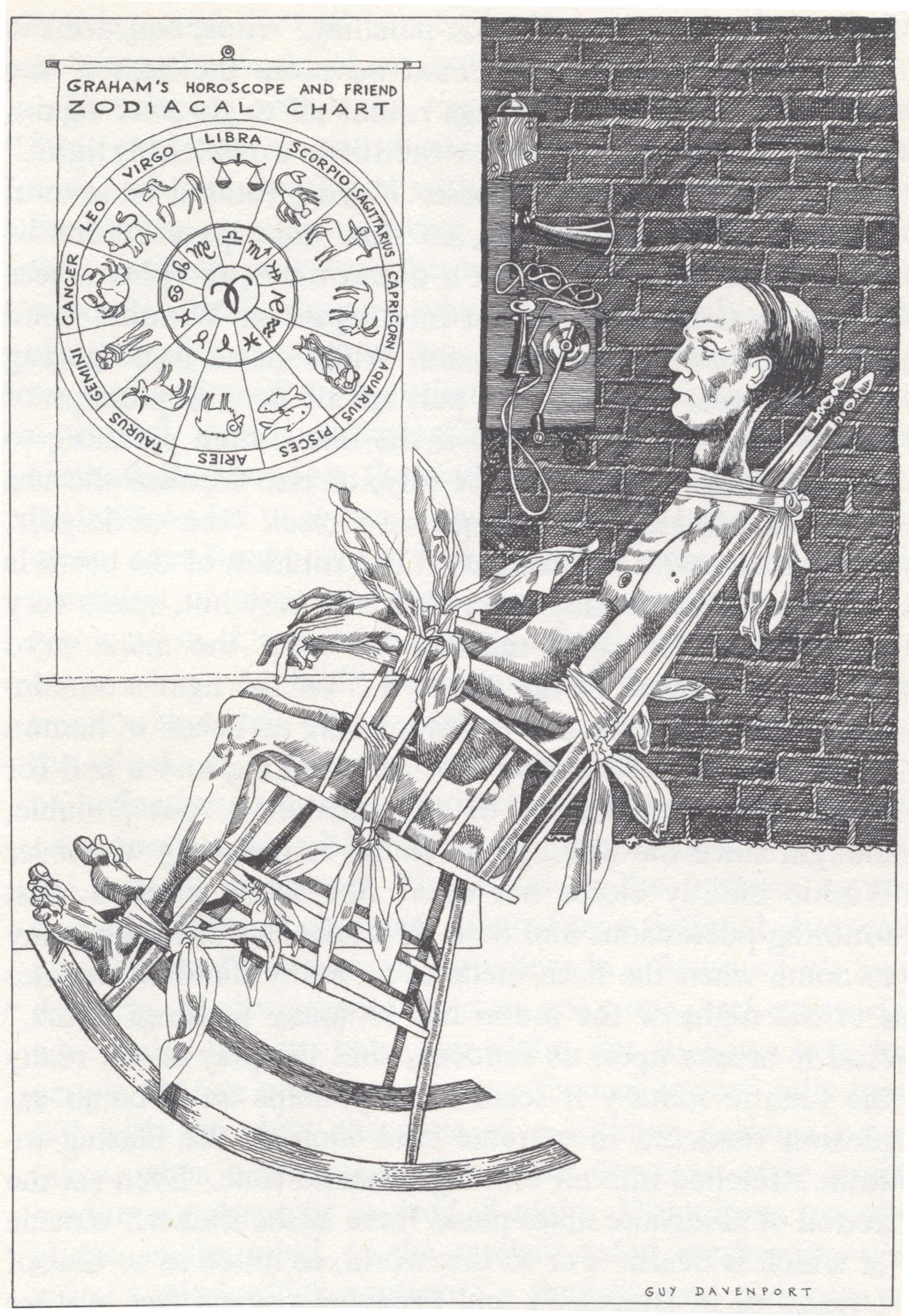
I am reminded of another Beckett work, his early novel Murphy (my personal favorite), which begins: “The sun shone, having no alternative, on the nothing new. Murphy sat out of it, as though he were free, in a mews in West Brompton.” It turns out that Murphy is sitting naked tied to a chair with seven silk scarves.

I like to think of zazen like that, tied with the silk scarves of our senses to our zafus, naked to our own consciousness. The natural world, like the sun, goes on around us, and we are more or less separate from it, as though we are free, yet we are tied to our zafus, or our chairs (chair, of course, in French means flesh) wherever we find ourselves, such as a mews in London, or a dojo in New Orleans or Sewanee. In this way we savor the stillness, the repetition, the nothing new. 

This week we will have zazen on the day of the winter solstice. Solstice means “sun standing still” and has become an ancient universal symbol of the natural cycle of completion and renewal, emptiness and form. This is the turning of the Dao, when emptiness begins to become form, just as during the summer solstice, when form begins to become emptiness. 

Completion and renewal is a nice definition of our sitting still in zazen, too. We can drop off the past, drop off the future, and sit still in the present moment here and now. People use this dark time to take stock of the past year and to look forward to the next year. What dead skin can I slough off, and what new skin will I grow?

Let your zazen be your solstice, your “sun standing still.” Calm in readiness, an ember in the darkness of the darkest day of the year. I love it when the logs in the fireplace seem to be spent, and then suddenly they flare up again, finding one last burst of energy before the body of logs is spent.

Guy Davenport’s illustration to Samuel Beckett’s Murphy

KEEPING IN TOUCH

Kusen by Richard Reishin Collins

New Orleans Zen Temple

12 October 2025

You have all seen depictions of the Buddha in zazen, with his hands in the meditation mudra, as yours are now. I am sure you have also seen depictions of the Buddha with one hand raised in the mudra of reassurance or “no fear.” There is another important depiction of the Buddha with his right hand touching the ground called the bhumisparsha, or “earth-touching” mudra. 

Buddhist mythology elaborates on this gesture to explain that this is his call to the Earth goddess to witness his triumph over the temptations of Mara and to verify his enlightenment at Bodhgaya. (As though the Buddha needed such certification!) One of the Japanese names for this mudra, referencing this story, is gōma-in (降魔印), or the “demon-subduing” mudra. 

But do we really need the mythological narrative to explain what is obvious? Aren’t the Buddha’s fingers touching the earth at least as obvious as the finger pointing at the moon?

Pretty tale though the story of Mara and the Earth goddess is, the Buddha’s gesture is already clear and sufficient: his obvious and unmistakable way of telling us to keep grounded even as we seek spiritual enlightenment. After all, the most tempting of Mara’s delusions might be the lure of spiritual enlightenment itself.

This is why I prefer the more straightforward Japanese name for the gesture, shokuchi-in (触地印), simply “earth-touching.”

For Zen students, this mudra serves as a reminder that like rivers and oceans, we sit on the earth; like mountains and forests, we walk on the earth; like everything that arises from emptiness, we are earth. We are earth-bound creatures, even as our head touches the sky. This is zazen. In the posture of seated concentration, shikantaza, we become the living conduit between heaven and earth, between emptiness and form, between shiki and ku. We become buddha.

Deshimaru gives us a similar teaching about raihai (礼 拝), the ceremony that honors our connection to the earth with prostrations, laying our bodies on the ground in gratitude for and recognition of our extraordinary human existence, and for this extraordinary practice of zazen, where we are given the opportunity to defeat delusion (Mara) and escape suffering (samsara). This ceremony of touching the earth, says Deshimaru, completes zazen. 

The word sesshin means, as you know, “to touch the mind (or heart).” We come to sesshin and through intensive practice with others we become intimate with the heart/mind (shin). In the beginning of our practice we tend to take this intimacy in a very limited way, as touching our own mind. This is the necessary first step, yes. But once we have become more intimate with our own mind, we can then become intimate with other minds, so that in our mature practice we touch not just our own mind but the mind of everyone who is practicing with us, and not just those practicing with us but, by extension, all beings, both sentient and insentient.

I once named one of our sesshin the “ses-sangha” to emphasize this larger contact with the others with whom we practice, not just those in this room, but all those in the Deshimaru sanghas, and not just those in the Deshimaru sanghas, but all those who have entered the stream. And not just those who have entered the stream of Zen practice, but all those capable of entering the stream of Buddhism. In other words, again, all beings.

Whenever I come to New Orleans from the mountains of Tennessee, I am reminded of the importance of keeping in contact with each other. Contact does not need to be constant, but it should be often enough to keep us awake and on the path. This may be daily or weekly, as in the local dojo or temple, or periodically as with our quarterly zazenkai and sesshin. Or it might be after much longer periods. The amount of time is not important. I can’t tell you how many times a former student has reached out to me after five, ten, or twenty years to say something like, “Now I understand what you meant when you said ‘Don’t move!’” 

How, then, do we keep in touch when we are physically so far away? You know you can always reach out to me by text or email with your questions and comments about texts or practice. Since I have no curriculum for you, you must create your own curriculum, your own practice regimen. Since I have no exams for you, you must create your own exams. Zen practice is not like a college major: there are no set requirements spelled out for you in advance; you must spell them out for yourself. This is an independent study course. I am here to help you, but I cannot map your path. Only you can do that.

Just know that when you do zazen, you are already keeping in contact. When we keep in touch with ourselves, we keep in touch with each other. When we keep in touch with what is important, we keep in touch with the earth. 

Whenever you do zazen, remember: you are doing zazen with me. Wherever you are doing zazen, you are doing zazen with everyone in this room. You are doing zazen with Robert Livingston, whose head presses the sky, with Deshimaru and Dogen and Daruma. You are doing zazen with the Buddha, whose fingers are touching the earth. 

Smithsonian, 19th century