THE EIGHTFOLD PATH: MAP, MAZE, MARROW

Richard Collins, Abbot of Stone Nest and the New Orleans Zen Temple

QUESTION: I am wondering if you would be willing to offer some commentary on the Eightfold Path from a Soto perspective. Or maybe you can direct me to some foundational interpretations, possibly from others in the Deshimaru lineage?

ANSWER: I won’t speak broadly about the Soto perspective, nor for the Deshimaru lineage in general, but I can give you my own point of view informed by these traditions. I would refer you, first of all, to Dainin Katagiri's Buddhist Lay Ordination Lectures. While he does not deal there specifically with the Eightfold Path, what he says about the precepts might give you a sense of how I would answer your question. Taking the precepts (or the Eightfold Path) as literal or prescriptive is not helpful; if it were, one might as well go back to the comfort of the Ten Commandments and settle there. The Eightfold Path is not so narrow, at least not in Zen practice: it is an abstraction, a map with many possibilities, not an itinerary; it gives us recommendations, not commandments.

What I have in the last several years added to our Ordination Ceremony about taking the precepts is based on these Katagiri lectures (which Robert Livingston always assigned to new bodhisattvas to study before ordination, and I continue to do so). What is the opposite of "right" practice? (Or any of the other dimensions of the path?) The opposite of right practice is not wrong practice; it is literal practice, it is shallow practice. The opposite of wrong or literal practice would be subtle practice, nuanced practice, profound practice, realized practice, that addresses the reality of the present moment or situation, not some prescriptive dogma that tries to cover all situations. 

Another way to think about this might be contained in the “repentance” part of our Ordination Ceremony. When we “repent” during ordination we do so absolutely, formlessly. What does this mean? It means that we are not repenting for anything in particular that we have done in the past because we are embracing our karma in total even as we cut it and drop it. Repenting about some particular action reinforces the separation between subject and object. Instead, we repent absolutely not only for past actions but for past inaction, for present actions and inaction, and for future actions and inaction. Formless or absolute repentance is exactly the quality of our zazen: no object and therefore no subject; no subject and therefore no object. No separation. Not repentance, in other words, in what we might think of in the Christian or Jewish sense, but “repentance in suchness.”

So you can see that in Zen practice a simple interpretation (or execution) of the Eightfold Path is not possible. What is Right Livelihood, for example? Does it mean we can't work in a bar? Does it mean we can't butcher meat? Such simple-minded approaches reduce the path to an either/or proposition, a narrow road bordered by steep cliffs on one side and bottomless abysses on the other, like Scylla and Charybdis. Any narrow-minded interpretation of the guidelines provided by the Eightfold Path reduces the journey to mere obedience to mere abstractions.

Zazen helps us to avoid the narrowness of dogma, opening up the possibilities of practice rather than closing them off. Some people want the precepts and the Eightfold Path to tell them what to do, to discipline them, but these guidelines, like the precepts, actually liberate us. They are not, indeed, instructions to be followed; they are, rather, what occur naturally, automatically, and spontaneously if we are harmonizing with our own path in the cosmos. They ensue.

We could also say this another way. The eight folds of the path need not be taken simultaneously. That is, if we can wholly dedicate ourselves to take just one of these seriously, we are on the right path, the path of right practice, which can only be our own unique practice. More importantly, one turn of the eightfold path naturally leads into another. There are three categories of the eight folds: ethical conduct (sila), spiritual/mental discipline (samadhi), and wisdom practice (pranja). Each is inextricably linked to the others, like some benevolent maze. If we practice Right Intention, for example, we are naturally bound eventually to come to practice Right Action, and so on. 

You might remember the exchange between Bodhidharma and his four disciples when he asked for their understanding. The first three made their replies, and Bodhidharma said to them in turn, “You have my skin, you have my flesh, you have my bones.” But when Huike replied with a silent bow, Bodhidharma said, “you have my marrow.” All three had understanding, but Huike’s was the one that was formless, absolute, like Katagiri’s repentance in suchness 

All Buddhist sects and all Zen lineages tend to emphasize one dimension of the Eightfold Path over another, morality over discipline, mindfulness over livelihood, etc. In the Deshimaru lineage, we emphasize Right Concentration, which could be seen as the last, or culminating, part of the path (if we take them sequentially or hierarchically). But Right Concentration can also be seen as the first, the doorway, “the dharma gate of bliss and ease,” as Dogen described zazen.

This is where we begin on the path, with zazen; it is also where we end. As Deshimaru instructed his European disciples when he left them for the last time, “Just do zazen, eternellement.”
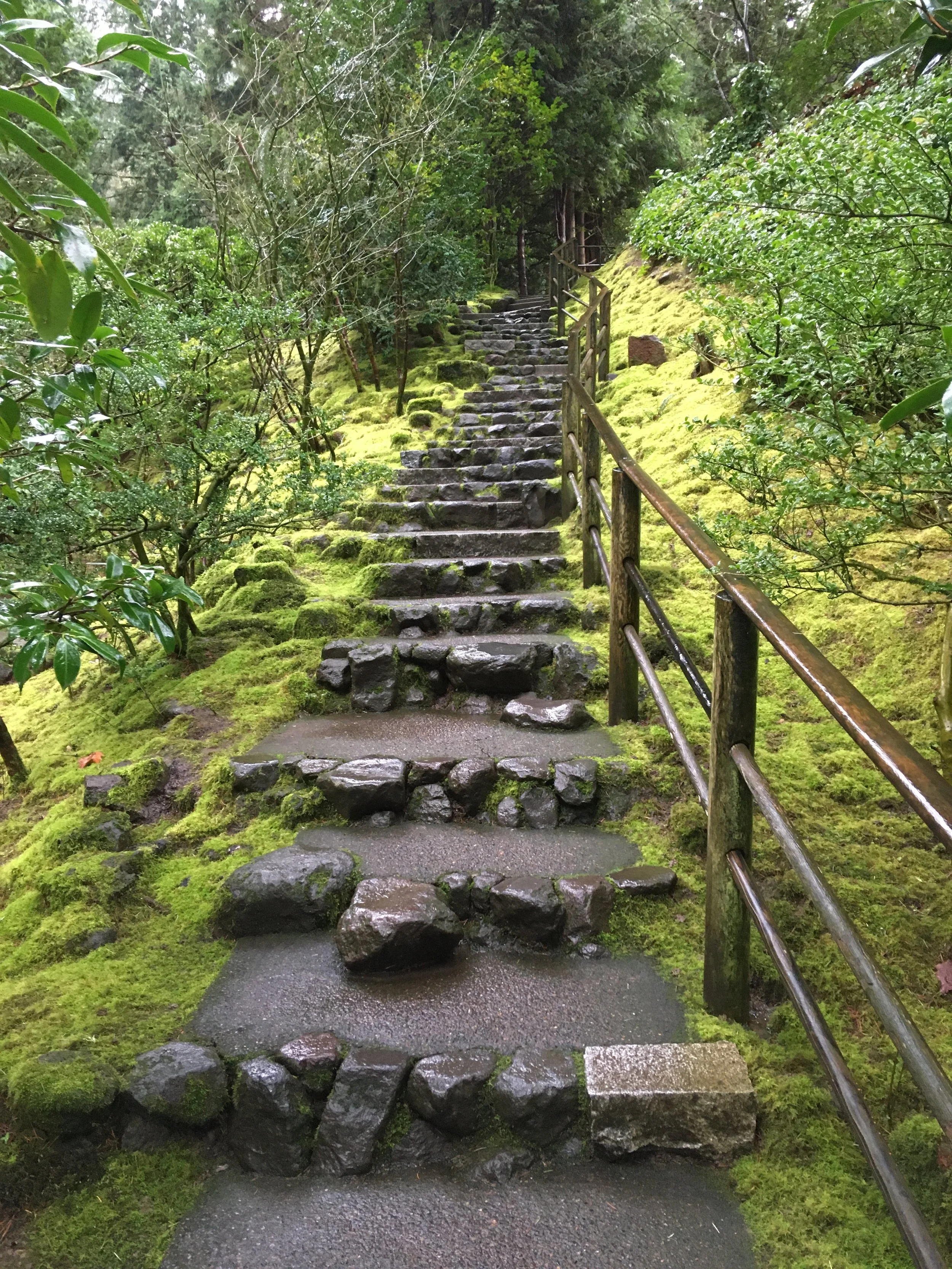
Portland Japanese Garden, Oregon. Photo by R. Collins, 2020

SITTING IN THE STREAM

Richard Collins at the Fall Equinox Eclipse Sesshin

19-21 Sept 2025

My senior year in high school in Southern California I failed two classes, English and Social Studies. Two teachers, Mrs Holman and Miss Lahewn, made me a proposal: if I promised not to attend their summer school classes, they would give me a passing grade and I could graduate. 

So in late summer, having hitchhiked north, I found myself sitting naked in a mountain stream that fed the Mackenzie River in Oregon, not far from where I was born. I was struck by the irony of the situation, being rewarded for my bad behavior by being given the freedom to explore my own path. But that was only the surface of the situation, the illusion. 

A more profound realization was occurring as I sat in that shallow stream, one that would accompany me for the rest of my life. 

As I set my book aside on the bank (I was reading André Pieyre de Mandiargue’s The Girl Beneath the Lion), I noted the clarity of the cold water coming down from the peaks and how the less I moved the more clarity crystallized. Silt settled. The rounded river rocks under the water emerged in sharp outline, colors muted but intense, rippling with insubstantiality just as the water seemed not fluid but solid, not a mirror but a magnifying glass into reality.

This, it occurred to me, was the still point of existence. Not the existence of the delinquent student, but rather the existence of what I would much later come to know as our “original face,” the one before our parents conceived us, the one before they were born. This realization was more than I could have expected from graduation day.

That experience did not reform me, not yet, but it did inform me that my path was to be different from the usual path, the path of the better (and worse) students in my graduating class, the obedient ones playing it safe and the ones without a cause heading for a cliff. 

I had other moments of realization along the way, still points where the whole of life in all its complexity appeared to make sense I could not articulate. Then, when I came to Zen practice, I realized that these moments did not have to be accidental, that there was a way not exactly to seek them but to prepare for them, to allow these still points to emerge from time to time, knowing all the while that there were fluid stones at the bottom of this solid stream, this dream.


We call taking Buddhist vows “entering the stream.” I took formal bodhisattva vows in 2001, but I had unconsciously entered the stream long before that, fifty-five years ago, on the day of my in absentia high school graduation.

Gold Beach, Oregon

GIVE UP HOPE--SO YOU CAN GIVE FULL EFFORT by Preston Thomas

"Demand not that things happen as you wish, but wish them to happen as they do, and you will go on well." –Epictetus

Preston Thomas

Jul 27, 2025

I want to go a little deeper on a point from last week: the need to “give up hope,” as Charlotte Joko Beck recommends in Everyday Zen. Here is the original statement: “To do this practice, we have to give up hope.” As I noted previously, that sentence could apply to filmmaking, jiu jitsu, or any hard endeavor. It applies to life overall.

In short, our lives become miserable when we cling to the hope that everything will go as planned. We’ll land the perfect job. Find the perfect partner. Buy the perfect house. Everything will go great if we can just plan our lives meticulously and work our asses off; by the force of willpower, we will make the world line up with our vision.

Nope. Life doesn’t work that way. Nothing goes according to plan. Much of the wisdom handed down to us by the Stoics and the Zen and Taoist masters can be summarized in a few words: Life is as it is. Yes, we may have free will, but that does not mean that we control our lives or the outcomes of our efforts. Everything is impermanent. Nothing can be grasped.

What we do have control over is the effort itself. Shojin, in Japanese Zen parlance, refers to our willingness to apply great concentration and effort here and now in order to stay on the Path. If we can do that, we can break the cycle of inattention. In doing so, we can also liberate ourselves from the cycle of our karma and our bonno. “Karma” is our action and its circle of cause and effect; “bonno” is a broad term in Zen for human problems: issues, afflictions, and/or destructive and disturbing emotions—the psychological baggage that most of us carry through our lives.

Marcus Aurelius, in Meditations, writes: “How does your directing mind employ itself? This is the whole issue. All else, of your own choice or not, is just corpse and smoke.” Taisen Deshimaru—a Zen master in my lineage—says in the book Mushotoku Mind: “[N]othing is absolutely and definitively predetermined. All karma can be corrected once its energy is channeled into streams that are more favorable to the Way.” Echoing the Stoics, Deshimaru goes on: “Right practice of the Way requires a regular, well-ordered, well-considered life and a respect for duty.”

This shojin or effort—in the here and now and in accordance with our duty—is what allows us to tap into jiriki (the power inside of us as individuals). That is what allows us to make it to the end of an exhausting work shift, do one more hard round in jiu jitsu practice, or grab that final shot at the end of a grueling film shoot, when everyone is exhausted and wants to go home.

Life is a marathon and not a sprint, as both Stoic and Zen writers indicate. For instance, consider the years that go into making a creative project or preparing for an athletic competition. No meaningful achievement can be done in haste. We should adhere to the proverb of the Romans: Festina lente, or “Make haste slowly.” Everything emerges from daily effort, which starts here and now—in this moment.

It is not easy to change your lifestyle or your body-mind. Growth and evolution are not pain-free. They require you not only to show up and persevere, but also to concentrate and make a wholehearted effort every day, year after year. Yes, our lives may consist of short-term sprints as we push beyond our limits. Ultimately, however, these short-term sprints serve the longer-term marathon of life.

I know, in my experience as a filmmaker, martial artist, and Zen practitioner, that any sort of transformation or evolution is a very slow burn. Last week, I wrote about the creative process and used the metaphor of campfire embers—a fire continually burning itself out into smoking ashes. The embers have to be reignited constantly.

Sometimes, we have to burn out. We have to reach a breaking point, or at least come close—in work, art, sports, and life. The breaking point might not be a major external catastrophe; it might be internal, and it might be subtle. I like to call it the “fuck it” point. Once we pass that point, we can really thrive. The illusion of hope begins to fade. Our ego—which my Zen teacher, Richard Collins, compares to a sumo wrestler bullying us in our minds—starts to have less control.

We slowly come to let go of the vain notion that we are the masters of life. We finally stop resenting all of the disappointment in our lives and see it for what it is: a great teacher. Joko Beck calls disappointment “our true friend, our unfailing guide.” If we are unlucky enough to get everything that we want (or think that we want), we miss out on the teaching power of disappointment.

In other words, getting what we want all the time causes us to wander through life trapped in the illusion of our ego’s false hopes and ambitions. We will be reaffirmed in pursuing what Jason Wilson calls “shadow missions,” and we will continue accumulating karma and bonno. Baseless ambitions will dominate our lives.

Shadow missions obscure our true mission: life here and now. The work that needs to be done—whether that is teaching, creating, starting a business, or simply taking care of your surroundings and your community. Everyone’s mission looks a little different. However, we all have great jiriki or internal power. An ability to transform our lives and our surroundings. To find that ability, you have to look deeply inside of yourself. No one else can do that for you.

——————————

NOTE: Preston Thomas’s “Zen Jitsu” blog can be found on Substack at the following link:

https://prestonthomas.substack.com/p/give-up-hopeso-you-can-give-full?utm_campaign=email-half-post&r=1091a1&utm_source=substack&utm_medium=email

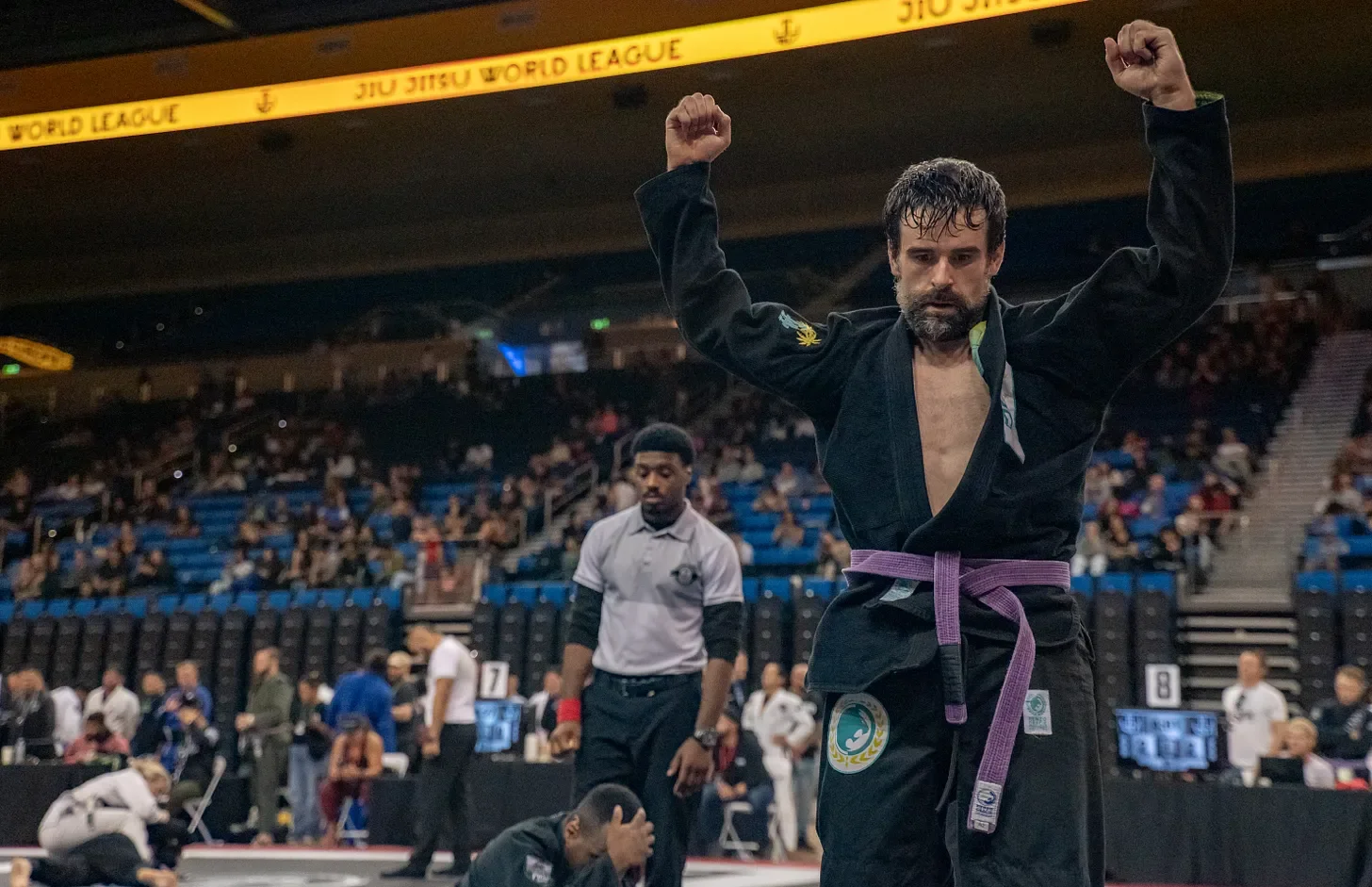
Jiu jitsu tournaments tend to go better for me when I detach from the outcome. Photo by Ponthus Pyronneau.

Misunderstanding Zen

Kusen by Richard Reishin Collins, Abbot

New Orleans Zen Temple

Winter Sesshin

Saturday, December 28, 2024

There is much to misunderstand in Zen teachings. Never take any instruction or description or pronouncement to be absolute—including this one.

Here and now, for example, does not mean just here and just now. 

“Without benefit of words or writing” does not mean don’t listen or don’t read.

“Thinking not thinking” does not mean not to think, nor does it not mean not-to-think.

In the same vein, “just sitting,” as you well know, does not mean just sitting.

The Mahayana Buddhist path of Zen is steep (the peakless mountain) but it is also wide (the shoreless river). It is not flat, not narrow. Discipline is important, but so is letting go. Zen may look exclusive from the outside, but from the inside of practice it is all inclusive. It is not either/or; Zen is both/and and neither/nor.

Misunderstandings about Zen can be pernicious, harmful. Too much emphasis on “here and now,” for example, can lead to self-absorption, hedonism, a lack of consideration for others. Being present does not mean a denial of the past or an evasion of the future, not at all. The present moment includes past and future. If we are always wrapped up in the present moment alone, we can never learn from our past mistakes and successes; we will never be prepared for what might come in the future. Here-and-now refers to the fact that the past and future exist only in the present, and when we truly live in the present we also embrace the consequences of the past and the responsibilities of the future. This is the karma which accompanies us into the present and the karma we are creating for the future in the present.

On the wall here in this dojo in the mountains of Tennessee hangs a calligraphy that says: “No calendar in the mountain monastery.” Yet, as the end of the year comes upon us, it is important to reflect on and to sit with the here-and-now of past-and-future. In the closing days of the year, we can pretend to claim some perspective on this concluding chapter of the year, acknowledging of course that calendars are an artificial reckoning of time and being. 

If you have not read Dogen’s “Uji” (or “Being-Time”), read it now. If you have already read it, read it again; it will look different to the time being you are now. Since you can’t read Dogen in the same way you would study a text for a class, go ahead and struggle with it, wrestle with it, sit with it, absorb it. It is one long koan, so don’t expect to master it with your thinking brain. You must embrace it with your whole being, like any other koan life gives you.

“Uji” is not an easy read. One thing Dogen makes clear, though, is that we are time beings. Our existence unfolds exclusively in time; time is how we “be.” We must grasp that we are only here for the time being: this is impermanence, this is mujo, this is Buddha Nature. It is not an idea, not a concept. It is an irreducible premise of our existence.

This is one reason we come back to sesshin, to remind us that when we waste time we waste being. We usually think of wasting time as doing nothing, but doing nothing saves being, as so many of the ancient Chinese poets told us: idleness is a virtue. Idleness unmasks the emptiness of much activity.

Even these truths are only half-truths. Truth-seekers don’t last very long in Zen practice. They eventually go to teachers who have no doubts, to practices that prop up their egos with self-improvement and virtue-signaling, to religions that reassure us that yes we are indestructible if only we sign over our eternal souls. 

Truth seekers have a hard time with Zen, however, because they want the simple answers, preferably set out in a list. They want the Ten Commandments or the Four Noble Truths, the Ten or One-Hundred-and-Eight Precepts, black and white, good and evil. Zen gives us something more difficult to digest: the way things really are, beyond the dichotomies that allow language to spawn delusive systems like politics and religion so that their distortions might hold power over us, tell us what is true and false. But the truth never looks like the truth. The truth is always—and can only be—half-truth. Zazen—and sesshin—are meant to verify and clarify our experience of reality. Nothing more, nothing less.

We are not here to provide answers to all questions. We come to sesshin to sit with the mysteries. We stimulate doubt, we bask in perplexity, we muddy the waters. But from muddy waters come beautiful flowers.

Sunflower Trail, Stone Nest Dojo, Sewanee, Tennessee

UNANSWERABLE QUESTIONS

“Don’t be deceived by the body, the mind, the world, or Buddhist teachings.”

— Tōrei Enji

This morning I plucked one of my old journals at random from the shelf, a volume covering Fall 2012, and found this quotation copied on the title page as an epigraph. It is by the famed painter and calligrapher, the 18th-century Japanese monk Tōrei Enji, who is often referred to as one of two “genius assistants” to the great Rinzai master Hakuin. 

Those acquainted even slightly with Zen practice will recognize the acuity of the first three deceivers: the body, the mind, and the world. We all know how the body can deceive us with its aches and pains, its distractions and desires and demands. We know how the mind can deceive us with its useless anticipations, its nervous imaginings, its self-serving excuses, and its whinging justifications. And we know how the world seems incapable of leaving us in peace, taunting us to desire what we don’t need, to fear what is harmless or irrelevant or absent, and goading us into premature action and unnecessary reaction. 

But Tōrei’s punchline, so to speak, is directed at these very Zen practitioners who are in danger of being deceived by the very Buddhist teachings that taught them to beware of the delusions of the body, the mind, and the world. The lore, of course, is full of paper dragons, painted rice cakes, and fingers pointing at the moon. Even the Heart Sutra warns us that Buddhist teachings are empty: no suffering, no cause of suffering, no end to suffering, no path to lead us from suffering. 

It is difficult to imagine other religions telling its followers to beware of being deceived by that religion’s teachings. And yet we see those religionists being deceived all the time because they have found too many answers and not enough questions.

Zen practitioners are not exempt from this sort of self-deception. We often find a certain enthusiasm in Zen practitioners that takes the form of a mimetic cleverness, a taste for shallow paradox, a tendency to cite koans and quotes attributed to the Buddha. This is a particularly insidious form of self-deception because these expressions may have a convincing ring of enlightenment. But the ring is only an echo. 

That’s the problem. If we are finding answers in Zen, beware. We need to pay most attention to the teachings that present us with unanswerable questions. To be able to sit in silence and stillness with the unanswerable questions: this is the core of Zen practice.

Richard Collins, Stone Nest Dojo, Sewanee Zen, 24 April 2025

THE GROWLING STOMACH SUTRA

17 November 2024, Stone Nest Dojo

This morning in the meditation hall

The chanting call-and-response of bellies 


Not the phonetic monosyllables of

The Heart Sutra but something even more 


Primal, more visceral, authentic, true

Responding to the energy in the room


Calling out to the third treasure: Sangha

Embodying the other two: Dharma


Buddha (you). Not just digestive juices

Percolating like coffee pots at dawn


Not cracking vertebrae during a yawn

But enchanting furnaces of energy (qi)


Direct transmission of ancient wisdom 

Hara-to-hara no benefit of words.

Max Ernst, Marine

EMBRACING THE SHADOW SELF: A HALLOWEEN KUSEN

Richard Collins, Abbot

New Orleans Zen Temple

31 October 2024


Yesterday I spoke about Zen Work, about the life work that comes with DOKAN, the Great Vow, the Ring of the Way. This work begins with working on yourself, really understanding yourself, recognizing yourself, not running away from yourself. And not just your nice, compassionate sunny-side self, but also your shadow self or selves, the ones that are not so savory.

This is hard work; most people don’t have the stomach for it. They want to go straight to peace and serenity, to nirvana, I suppose. But as Robert used to say, Don’t try to find nirvana. Nirvana (extinction) will find you, soon enough.

Two chapters of Philippe’s new book Zen Fragments address this subject. In Chapter 4, entitled “Shadows,” he writes: 

We must understand our shadows. And to understand them we must look at our personal history, our own individual karma, and obviously the illusions which create these shadows.

– Philippe Coupey, Zen Fragments: Teachings and Reflections of a Zen Monk in Paris (11)

In our tradition when someone requests bodhisattva ordination, we ask for a brief autobiographical statement about the person’s path that has brought them to this point. This is not an empty formality. The personal statement is helpful to the teacher who needs to understand the ordainee, where he or she is on their path, where they have been to get here, their karma and how they conceive of it. But the personal statement should be even more helpful for the ordainee in understanding the step they are taking. 

This is why the statement must not be self-hagiography. It is not a job application, not a resume in search of approval. I often send back first drafts and ask the ordainee to rewrite it and dig a little deeper. The personal statement needs to at least begin to take a look at the shadows, as Coupey calls them, which he also calls karmic knots. These karmic knots must be unraveled, like tangled Christmas lights, periodically. The personal statement is just the first step in an ongoing examination of motivation and intention, a first step in the discovery of what practice is in relation to our karma, our past actions, our present actions, and our future actions. This is the work of Zen practice, after all. 

Halloween is probably a good day to discuss these shadow selves. These masks that we wear; or should I say, the masks that wear us.

Chapter 5 of Zen Fragments is called “What Brings You to Practice.” This chapter is about more than just a narrative of one’s path to the dojo. It is really about the necessity of self-examination, to discover not only your shadows, but in the process discovering your KAN, the Great Inner Vow to continue to practice. It is the rock around which you can center your search. It is the inner altar in the direction of which we bow every time we enter the dojo.

Japanese Hyotokoto Comic Mask of the Fool

ZEN WORK 作務

It is upon us to begin the work;

It is not upon us to complete it.

– Talmud

Zen work begins with samu 作務. Samu is physical and sometimes intellectual labor done in the spirit of mushotoku, with no thought of personal profit, without complaint or compensation, for the benefit of the sangha. It is a form of fuse (or dana, a donation freely offered). 

But the gift of samu is not limited to working for the sangha, just as the sangha is not limited to the people you practice with in the dojo. Yes, samu can be cleaning the dojo, or building a temple, or working in the office. But like other aspects of Zen practice, samu only begins in the dojo. Samu radiates into every other aspect of our lives, just like zazen. It’s how you take the spirit of samu, which is also the spirit of zazen, into the world that matters.

We used to have a fellow at the Temple who complained about samu. One sesshin he left early, in disgust, saying he came to do zazen and have satori, not to clean toilets. He wanted to concentrate on ku, to grasp ku, to attain ku; he couldn’t comprehend that ku becomes shiki, shiki is in fact exactly ku. Another way of putting this is, he wanted to complete the work, but he wasn’t willing to begin it.

The first vow of the bodhisattva (the vow that contains all the others) is to save all beings. We know that we can never complete this work, we can only begin it. If we had only to take care of our own sangha, that would be one thing. But the people we practice with in the dojo are only the tip of the iceberg. The true sangha extends into the community, the country, the world. 

Our samu also extends or radiates into the world. We might think of our work in the world to be separate from our practice in the dojo. This is a mistake. The dojo is not a refuge, not an escape, although sometimes it might feel like that. Our jobs can sometimes annoy or oppress us, so that the dojo feels like a refuge, but this is because we don’t recognize the value of our work in the world and its relationship to Zen practice.

With practice, one’s life work becomes Zen work and Zen work becomes one’s life’s work. No separation between the two. I am not talking about the tasks you might complete in a job, but the end result that can never be completed. This is true no matter what your job, whether you are a janitor or a doctor, a lawyer or a bricklayer, a musician or a monk.

The Talmudic saying can be a helpful inspiration on how to take work not only in our day-to-day lives but also in our Zen practice. “The work” that is upon us implies that we have a mission in life. This mission may be modest or it may be grand, but it should be one that we are willing to undertake with a deep vow. And if it is a worthy mission, it is life work that can’t be completed in our lifetime.

After Deshimaru, Philippe Coupey calls this vow kan (of dokan, the ring of the Way). It is a vow that we make almost unconsciously, and once it is made it cannot be discarded, even though we think we might be able to get away from all the existential responsibility that it implies. And yet we are not bound by this vow, only by our determination.

Some translations of the Talmudic saying suggest that such a vow is not freely made. For example, instead of “the work is upon us,” it might read “we are obligated to begin the work.”

This reminds me of the distinctions that can be made between the interchangeable Biblical translations of timshel as the imperative “thou shalt” or “doest thou,” and the more permissive “thou mayest,” distinctions that I have discussed my book No Fear Zen in regard to Steinbeck’s examination of the word in East of Eden. Of the various readings, “thou mayest” is the most edifying because it throws the burden of responsibility for right action onto us and our free will. Ethical action is a choice not an obligation, and a vow like the bodhisattva vows is a positive first step of intention, not a contract meant for completion.

The distinction between an obligation imposed upon us and a choice we freely make is crucial. “We are obligated” and “it is upon us” both suggest a burden imposed on us by outer forces. But the passive construction of these formulations beg the implied question: obligated to whom or by what? Jewish belief and practice might say that God imposes this obligation. Similar exhortations from the Bible, such as that in Philippians 1:6, suggest that Christians, too, have no choice since they can’t even begin the work because it can only be started by God and finished by Christ. (“...being confident of this very thing, that He who has begun a good work in you will complete it until the day of Jesus Christ” (NKJV). 

Here the distinction between the Buddhist “work” to be done and that of the Abrahamic religions could not be more pronounced, since the latter essentially deprive us of considering this work to be our free choice. (Similar ways to avoid responsibility for our own actions are often given by the logic of scientific determinism or certain Buddhist beliefs that we are controlled by what might be called karmic compulsion.) 


The bodhisattva vows of Mahayana Buddhism, though, begin with an intention of right action to complete an impossible goal: “Beings are innumerable, I vow to save them all.” We take on this work at our own direction. [Non-Zen Buddhists, however, might argue that our actions are subject to the “other power” (tariki) of the Buddha rather than the “self power” (jiriki) of our own resources.] Rather than suggesting an “obligation” we are born into, or a burden that is imposed “upon” us, the Talmudic saying might also be expressed in a way that aligns with the worldly work of the bodhisattva: “It is up to us to begin the work / It is not up to us to complete it.” This “up to” rather than “upon” makes a perhaps subtle difference. We willingly take up the responsibility not only for our own actions but for the well-being of all beings. This is work that is, obviously, impossible to complete, but quite possible to begin again and again and again.

Samu in the sewing room. New Orleans Zen Temple, Camp Street. Winter Sesshin, 2019.