Richard Collins, Abbot
In the summer 2026 issue Tricycle published my poem “In the Posture of the Water Dragon” after a poem by Wang Wei from my collection Stone Nest (Shanti Arts Publishing, 2025).
Every translator makes a poet their own, of course, more or less unconsciously. But I do not know Chinese and do not presume to be a translator. Mine is an “after” poem that echoes the original and engages in conversation with the poet across the distances of time, space, culture, and personal awareness.
All of the poems of Stone Nest are to some extent “in conversation with” the ancient Chinese poets. Another poem begins: “Here on the mountain we may not be closer to God / but we’re closer to the ancient Chinese poets / who chose to be closer to nature and themselves.”
Some of these poems began as loose translations or “versions” of the original poems, usually following literal translations that lack articles, tenses, plurals, and even person or point of view. Many of my “versions” did not make it into the book, being closer to being translations than responses. All of the poems in the book are in the spirit of the Chinese poets.
When I used to teach world literature I would have students compare several translations along with a literal translation to “triangulate” the many possibilities a translator has to work with in English.
Here is a translation of Wang Wei’s poem by Burton Watson, one of the more prolific translators of Chinese poetry. (The Columbia Book of Chinese Poetry, translated and edited by Burton Watson. New York: Columbia UP, 1984, p. 202-03.)
VISITING THE TEMPLE OF ACCUMULATED FRAGRANCE
I didn’t know where the temple was,
pushing mile on mile among cloudy peaks;
old trees, peopleless paths,
deep mountains, somewhere a bell.
Brook voices choke over craggy boulders,
sun rays turn cold in the green pines.
At dusk in the bend of a deserted pond,
a monk in meditation, taming poison dragons.
This seems very straightforward, but certain choices have been to pin down what was in the original Chinese ambiguous.
Even the title makes a choice that is not clear in the original. Sometimes called “Stopping at Incense Storing Temple” it is not clear whether the narrator actually finds the Temple or is simply looking for it. Do they actually “visit” or “stop” at the temple or do they “pass by” it and sense its presence by its strong fragrance?
One literal translation of the poem (http://www.chinese-poems.com/incense.html) looks like this:
STOPPING AT INCENSE STORING TEMPLE
not know incense store temple
few li enter cloud peaks
ancient trees no person path
deep hills what place bell
spring sound choke sheer rock
sun colour cold green pines
dusk empty pool bend
peace meditation control fierce dragon
Even a so-called literal translation, however, can show great variation.
Wai-Lim Yip’s literal version is more precise in recognizing the ambiguity of connotation in certain words and phrases. (See Wai-Lim Yip, Chinese Poetry: An Anthology of Major Modes and Genres. Durham, NC: Duke UP, 1997, p. 189.) Where the smell of incense has been “accumulated” or “stored” or “piled up” or “heaped” in other versions, in Yip’s version it “teems.” (“Stored” makes it sound as though the temple warehouses its stock of incense there, instead of the sensory accuracy of smelling a place that has been infused with the odor of incense burned over the course of many years.) The sound of the “pond” or “pool” in other versions becomes a “fountain” or “spring” in Yip’s. Where the pool “chokes” in other versions, in Yip’s it also “sobs” or “swallows.” Where others see a “craggy” or “sheer” rock, Yip’s becomes “perilous.” And what others call “peace meditation” that “tames” or “controls” a “poison” or “fierce” dragon becomes for Yip the more literal “pacifying Ch’an or Zen” that “exorcises” a “poisonous” dragon (that he upgrades to a “virulent dragon” in his final version).
The result is what seems to me to be the clearest “translation” of Wang Wei’s poem:
PASSING THE TEMPLE OF TEEMING FRAGRANCE
Where is the Temple of Teeming Fragrance?
Miles and miles into cloud-peaks.
Ancient trees; no man’s path.
Deep in the mountains: where, this bell?
Fountain sobs, swallowing perilous rocks.
Sun’s color chills green pines.
Dusk. At an empty pool’s bend,
Meditation exorcises heart’s virulent dragon.
I wish he had retained “Ch’an” or “Zen” for 禅 in place of a mere generic “meditation.” And “exorcising” the “virulent” dragon seems to be exalting the dragon into the status of a demon and its poison into an infectious disease in a somewhat melodramatic final flourish. But otherwise Yip’s choices seem justified and well-informed, and his mostly five-word lines echo nicely the five-character lines of the original, while not trying to smooth out the staccato images into colloquial English.
My own version, in conversation with Wang Wei’s poem, changes the meaning while inflecting it with my own experience while living on the 22 acres of the Zen hermitage called Stone Nest in Sewanee, Tennessee.
IN THE POSTURE OF THE WATER DRAGON
After Wang Wei
To avoid the stink of incense at the temple,
I wander a few miles along a foggy trail.
No one anywhere on the ancient path between the trees.
A bell rings deep in a dark ravine,
a spring gurgles down a steep rock gulley.
Bright chestnuts chill the prism of slanting light.
At dusk I sit by the calm deserted pool
in the posture of the water dragon.
In all these versions we see a similar core experience of the juxtaposition of an absent but fragrant temple (searched for, missed, or left behind) and a present fountain, spring, or source (where the struggle for enlightenment or awareness is conducted in the solitude of nature).
Still, I think you can see Wang Wei’s point and, in contrast, mine. Two things stand out at the beginning and end. First, in the opening line, the attitude toward the fragrance of the “incense accumulating temple” in the other versions is different from the temple’s “stink” in mine. Then, in the closing line, the toxic dragon that meditation is supposed to exorcise becomes simply the water dragon, or myself, that Zen reveals in the reflection of the pool.
In Watson’s version there is an unidentified “monk in meditation, taming poison dragons.” In my version, I take “the posture of the water dragon.” The posture I am taking is not that of some spiritual dragon-slayer but my own (born in 1952, I am a Water Dragon in the Chinese zodiac). In Zen practice, as opposed to generic meditation, poison dragons stand for the bonno (illusions or delusions that come from the three poisons of anger, greed, and ignorance). Watson’s monk tames the poison dragons within to become human again, alluding to the myth. (Watson’s footnote explains: “The poison dragons are passions and illusions that impede enlightenment. They also recall the tale of a poison dragon that lived in a lake and killed passing merchants until it was subdued by a certain Prince P’an-t’o through the use of spells. The dragon changed into a man and apologized for its evil ways.”) By taking the posture of the water dragon, however, I am simply becoming myself, dropping off body and mind to become my true self, the one Kodo Sawaki says is the one we have not thought of.
The point is, to return to the beginning of the poem, in order to become our true self we must leave the “stink” of the incense-accumulating Zen temple behind. Not literally perhaps, and not forever, because we can always return to the ritual and the forms; but to really become ourselves we have to leave all temples and all religions behind, return to the natural state, our own nature which is empty, and like the fountain, the source, far from the stink of Zen.
That path is long and foggy, but it is an ancient path, and when we reach the source, we can drop the poses and become ourselves in our own posture. The ritual and forms of the temple are fine, but zazen is the key. Zazen does not need a formal ritual space but only a space at the source of one’s own nature. A temple is like a gym or training ground for the warrior within; it is not where the battle takes place, which is within oneself.
In my own experience, I left the New Orleans Zen Temple twice. First, I left for five years (2005-2010) to do battle on my own. I did not leave the practice of zazen, of course, but set up dojos where I found myself (in Alexandria LA and Bakersfield CA) when I was asked to. When I returned, my teacher didn’t punish me for leaving, he asked me to take monastic ordination and to take over the temple for him.
The second time I left the temple of accumulated fragrance behind was when the building on Camp Street was sold and the Temple dismantled. This time I left it behind the way a cicada leaves its exoskeleton. (In “The Dead Master,” published in Still Point Arts Quarterly, I compare the Temple to Robert’s exoskeleton, and him in old age to the Greek figure Tithonus, who asked the gods for eternal life but forgot to ask for eternal youth, and therefore was doomed to wither away and chatter for eternity in the form of a cicada.) The true temple, however, like the cicada, is not to be found in buildings or empty exoskeletons but in the living body that takes on new incarnations.
THE DEAD MASTER
Like a mokugyo
or an abandoned
temple
the empty body
of the cicada
remains
its song
an endless
echo.
The new battles with poison dragons continue to occur at Stone Nest. Not with the forms or fragrances, not with external pressures and temptations, but with myself.
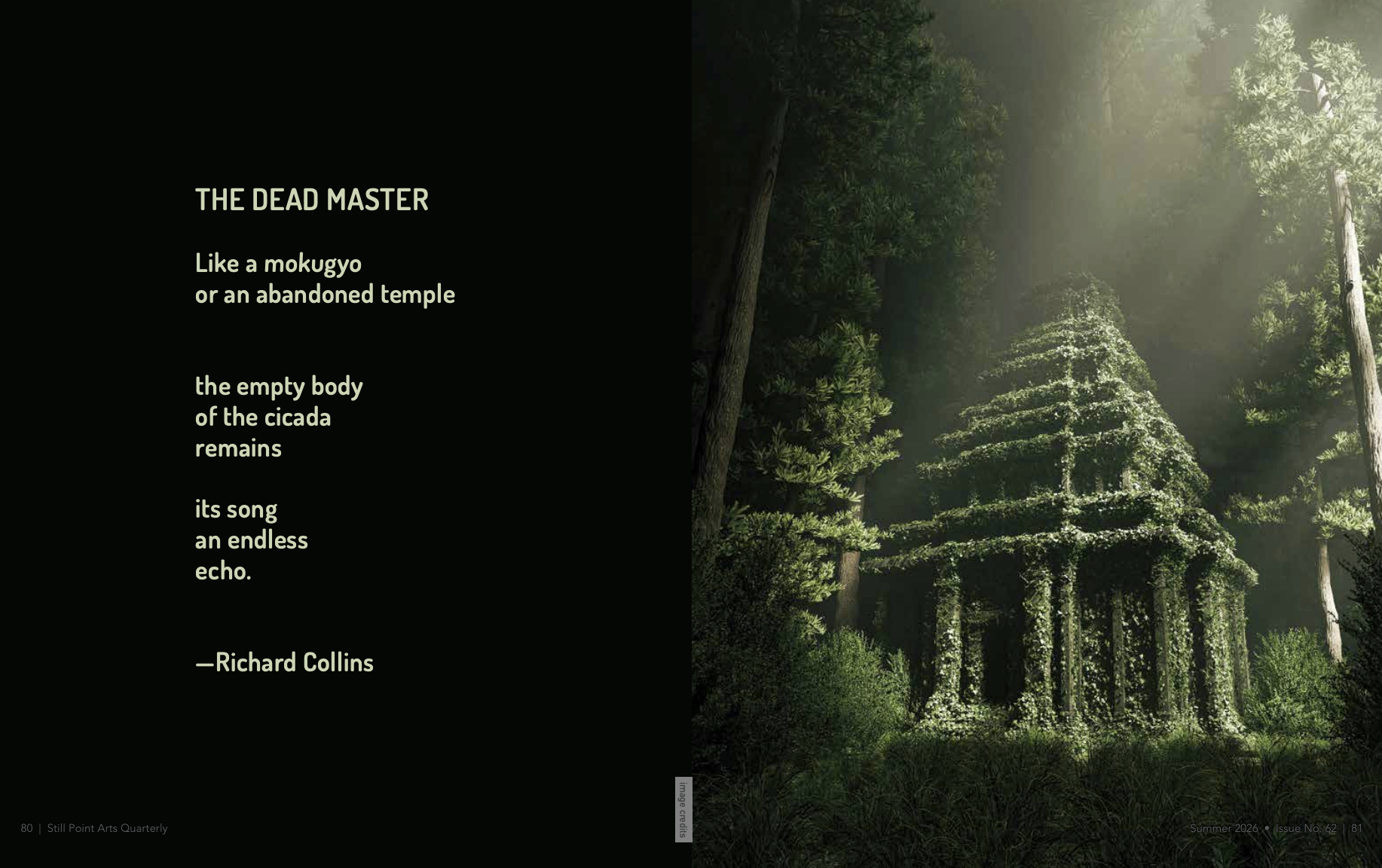
Courtesy of Still Point Arts Quarterly.