At the recent Japan Fest at the New Orleans Museum of Art, we set up our Zen meditation space in one of the galleries, as we have for the past several decades. The galleries change every year, but the practice of zazen remains the same.
This year we placed our zafus along the walls and invited curious visitors to just sit for a while in the silence of their own reflection even as the noise in the museum surrounded them. This is the practice of zazen, sitting upright in the deep calm available in a calamitous world.
In the center of our gallery, high on a rough cypress plinth, sat a sculpture by Louise Bourgeois. It is called Female Portrait, but it is really a Medusa in white marble that anyone might mistake from behind to be a Buddha. And for the duration of the day, she became the central figure of our temporary temple, our Medusa Buddha.
In Buddhist iconography, snakes hold a sacred place. The Naga serpent or dragon was known as a protector, metamorphosing into shelters or set at entrances to ward off unwanted influences or visitors. These might be actual storms (sun and rain) or symbolic storms (delusions, angers).
You can see the sacred serpent in countless representations of the Buddha, depicted either realistically as an actual python spreading its cape behind the Buddha to protect him from the elements under the bodhi tree, or sometimes abstractly as a flared backdrop like a throne.
Nagarjuna, whose name means Noble Serpent, explored the profound wisdom of emptiness, bringing back these secrets from the underworld of serpents. And so on….
Medusa made the perfect Buddha for us that day, shielding us from the noisy festival outside our gallery temple. Self-sufficient, Medusa needs no outside protectors, her strength comes from within, as in Zen, her self-generating serpents enveloping her body with coils of pure white marble. She is her own Naga, just like a monk in zazen.
Medusa famously turned men into stone with her gaze, but this is only her most popular and simplistic role. She is also an icon of rage at being violated and not just by the gaze of men (or rape by Poseidon), a gaze she returns in spades.
In Louise Bourgeois’ interpretation, though, she seems to have conquered her rage. There is in her buddha-like shape and grounded posture no rage, only a ghostly peace; no writhing, only the stillness of marble purity. Like a perfectly balanced androgynous Buddha.
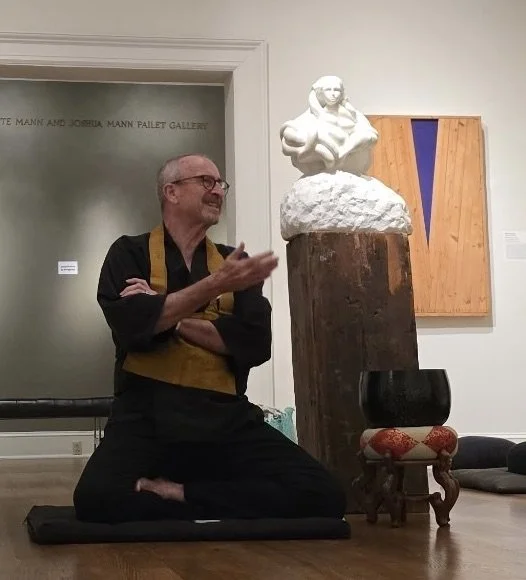
Abbot Richard Collins speaks to an audience at Japan Fest on 10 October, 2026.
