Richard Collins
Teisho, Stone Nest Dojo & New Orleans Zen Temple, 1 November 2026
True vision isn’t just seeing seeing. It’s also seeing not seeing. And true understanding isn’t just understanding understanding. It’s also understanding not understanding. If you understand anything, you don’t understand. Only when you understand nothing is it true understanding. Understanding is neither understanding nor not understanding.
– The Zen Teachings of Bodhidharma (trans. Red Pine)
Yesterday, on Halloween, I went to see the film You Can See Everything. Even though it has gotten a lot of hype, I was one of only four people in the theatre. This is rural Tennessee, after all. But Halloween was a fitting time to see it because the film showcased the masks we wear, the realities we deny, the roles we play, and the delusions that can destroy us if we let them.
It is one of the most “Zen” movies I can think of without being obviously about Zen or Buddhism, as are Jim Jarmusch’s Ghost Dog or Kim Ki-Duk’s Spring, Summer, Fall, Winter, and Spring What I mean by that is this film enacts the problems of illusion and delusion in a real-life contemporary setting and doesn’t let us off the hook by telling us what to conclude. Even though “you can see everything” you end up seeing nothing, or rather you don’t know exactly what it is you’re seeing. That is the film’s power.
The Academy of Motion Picture Arts and Sciences is going to have to do some soul searching, like what the Nobel Academy did when they decided to award Bob Dylan the Nobel Prize for Literature; they are going to have to rethink what a “Best Picture” is.
What if a documentary happens to be the “best collaborative effort of many people, taken together,” which is the vague MPAS definition to qualify for the Oscar for “Best Picture”? No documentary has won “Best Picture” before because they are usually ghettoized in a separate category called “Documentary Feature” and not taken seriously (ironically) as film art.
The Golden Globes is more restrictive, awards going to the “Best Motion Picture – Drama” or, in the acting categories “Best Actor or Actress" for the Oscars and “Best Performance by an Actor or Actress” in the Golden Globes.
But what if the “performance” is not by an actor playing a role but by a “real” person appearing as themselves, as in a documentary film?
The second half of this “documentary” complicates the issue by bringing in Amanda Seyfried who had already played the character of Elizabeth Holmes in a Hulu TV production called The Dropout. But in the second half of this film Amanda plays herself reenacting Elizabeth and thus going beyond being interviewed and actually acting. Does she deserve an Oscar as “Best Supporting Actress”? Most of the time she is not “acting” except to the extent that she may be “acting” even when she is just being herself.
That brings up the main theme of the film, which is to what extent are we ever authentically ourselves, not playing a role, especially in the corporate and film worlds? The key to this theme is a phrase that comes up repeatedly. A New York Times profile on Holmes quoted her — correctly or incorrectly — as saying “They’re not playing me. They’re playing a character I created.” But what is the difference between “me” and a “character” I create?
No one is exempt from this character-creating persona, even the filmmaker himself, Nathan Fielder, who began shooting as an off-camera presence and was eventually incorporated into the presiding narrator and a main character, along with Elizabeth Holmes and Billy Evans, creating the triangle that all good drama exploits ever since Sophocles introduced the third actor, the tritagonist, who complements and complicates the relationship of the protagonist (Elizabeth Holmes) and deuteragonist (Billy Evans). It’s a classic structure, not unlike the roles played by Gatsby, Daisy, and Nick Carraway in that classic American narrative about money and success, love and obsession, truth and deceit.
What makes it a Zen movie? It behaves like a koan. You can see everything but that doesn’t mean you see everything. You don’t see things the way they actually are. You only see them in ways they are presented to you by the media, by advertising, by the legal system, by the movie industry. Above all you cannot trust the people (characters) themselves, who are all unreliable narrators. They are all created (and curated) for our consumption, either by their mediators, or by themselves. By the end of the film you have seen a lot but you have no definitive answer. In that way, though, knowing-not-knowing, perhaps you are a little wiser.
This is not usually the case with a documentary, which is supposed to inform you and come to some resolution about a subject: thesis, development, conclusion. One critic complained that he likes more “truthiness” to his documentaries. We are certainly informed, but we must confront our own unknowing about whether Elizabeth is “authentic” even when she is testifying to her own truth. Her most revealing statement, I think, might be when she is asked if she knew Amanda was going to visit Billy. She says “I don’t know if I knew.” That seems to apply to a lot of her self-awareness. She seems so confused about her “crime” that she seems to have convinced herself that she doesn’t know what she knew. Or she is stonewalling us all (and herself) with that sanpaku stare.
It’s a long movie, three hours, but it is fascinating from beginning to end. This has a lot to do with the use of stillness and silence. Sustained close-ups encourage us to “read” the faces, especially the eyes of both Elizabeth and Billy with their unblinking wide-eyed arch-browed challenge to see into their soul (if they have one—and they seem to think that they have one, that they share). Most films discourage us from thinking about a scene by quickly and constantly cutting from one image to another in rapid succession because they are afraid we might get “bored.”
The length also has to do with the use of silence. Ari Balouzian’s score is extremely effective in that it is unobtrusive but conducive to setting the contemplative mood. (Balouzian also composed the score for the recent reality-based film Primetime.) You hardly know there is a score at all until the credits come on. But it provides diacritical marks and punctuation that conduct our emotions and suspense, often with the plucking of a base like the ticking of a baritone clock or the thumping of our hearts. The resemblance to the Zen-inspired compositions of Philip Glass is striking. There are Glass-like monotonous repetitions sprinkled with bells and haunted by distant drums or an occasional piano riff. Very technologically eerie and surreal but also primal and tribal.
We are reminded that music is really silence punctuated by sound, not the other way around, the most extreme example being Cage’s famous “4’ 33”” that I once saw performed in a concert hall in Bucharest. The Heart Sutra tells us that form is emptiness and emptiness is form (phenomena arises out of emptiness, emptiness arises out of phenomena, but they are the same thing). Emptiness is the profound silence which we sometimes forget in our pursuit of the surface stimulation of sight, sound, and meaning.
Poetry is a blank page punctuated with lines of sound, and scripts (which appear from time to time in the film as a reminder that this is all written) are arranged on a page with lots of white space to separate direction, actor, and speech. Fielder insists that dialogue is really silence punctuated by speaking, which most directors suppress with overbearing sound to drown out any thoughts we might be tempted to have while watching their spectacles, since reflection is likely to reveal how stupid they are.
Ralph Waldo Emerson predicted a long time ago that there would come a time when a clear distinction between fiction and nonfiction genres would be dissolved into “narrative.” There used to be a clearer distinction between fiction and nonfiction, but we have created a new name for an old genre that blurs that easy and inaccurate dichotomy: “creative nonfiction.” Perhaps we should have a film genre called “creative documentary.”
Fielder has certainly blurred the genres creatively — not to confuse us, but to clarify the paradoxes of reality. As Amanda Seyfried concludes with the final speech in the film, “It’s complicated.” Something we rarely have to face in the movie theatre but face every day on the cushion watching the blank wall during zazen.
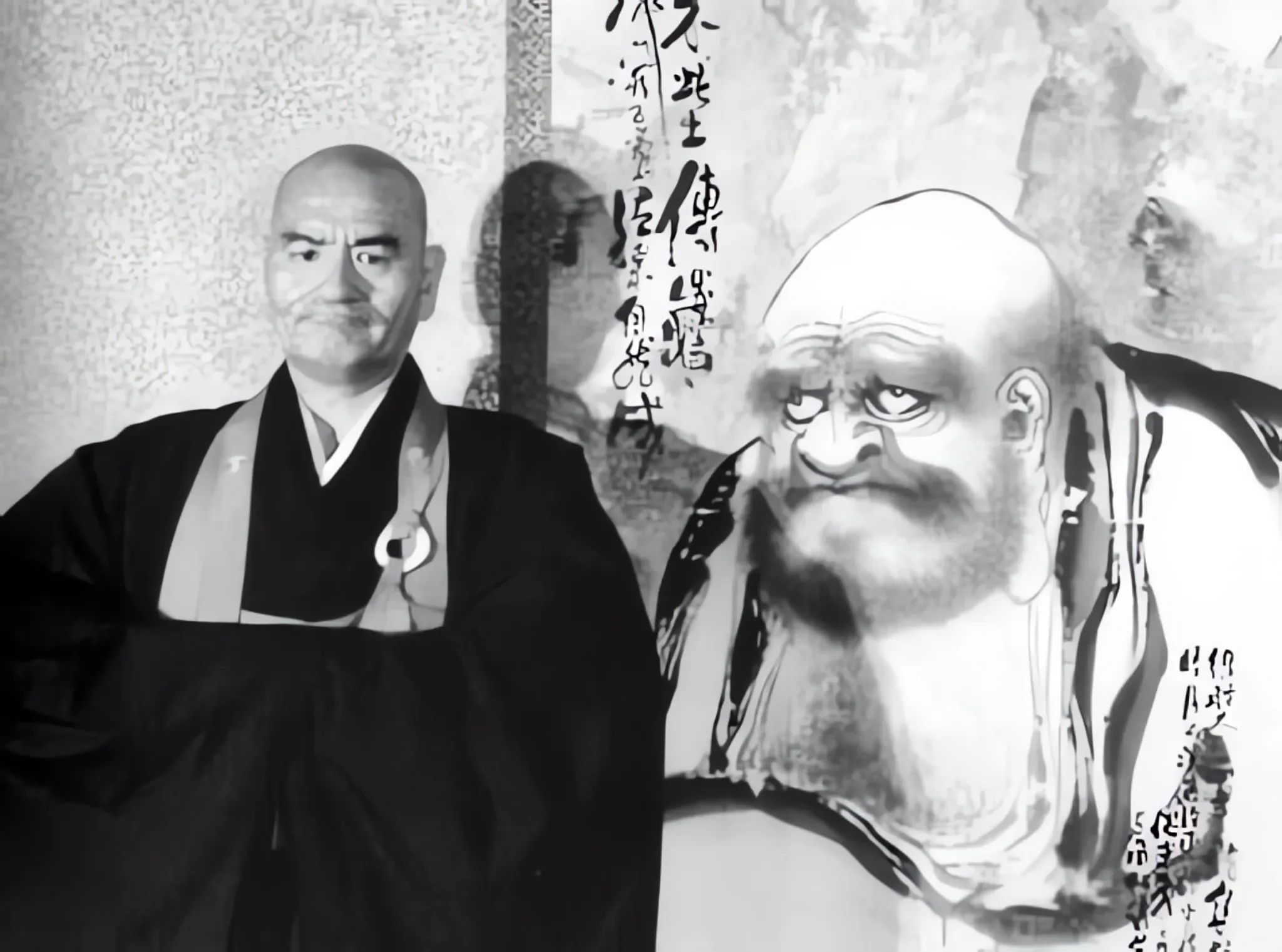
Taisen Deshimaru, the Modern Daruma, with a portrait of the Ancient Daruma (Bodhidharma)
