Richard Collins, Abbot
Stone Nest Dojo
28 June 2026
Today I want to talk about the han. This is the neglected stepchild of the instruments. It is the first one we learn how to play, even though very few of us play it very well. It is not given the attention that it deserves.
The han is what calls us to enter the dojo. But it is not just a bell like the school bells that told it was time to get to class, or to get out of class. If that’s all it means to you, try to give it a little more respect.
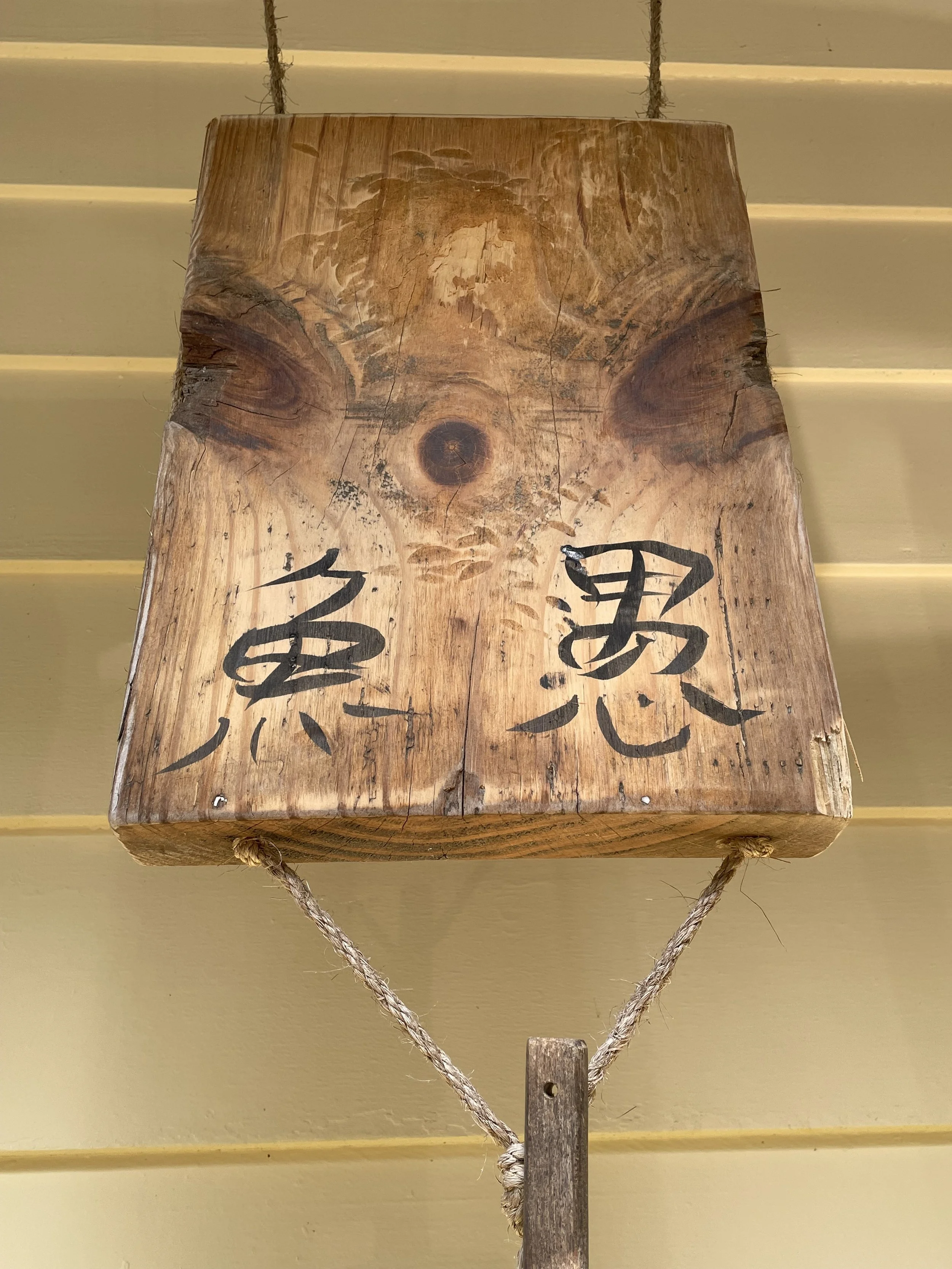
Some temples have inscriptions on the han, in English or kanji, that spell out what its sound means. Ours never has. Its meaning has always been implied in the sound of wood mallet on wood plank.
For a long time I have thought about adding an inscription to the han here at Stone Nest. But I have never really felt that it was time or that I had come up with the right message.
I knew that it should not be in English, as some temples have it. We don’t chant the Hannya Shingyo in English, so why should the han speak English?
I knew that the inscription on the han at, for example, Tassajara was not right for us. Theirs reads something like this: “Wake Up, Life is transient, Swiftly Passing, Be Aware, The great matter, Don't waste time.”
I have almost finished the first draft of my book on Robert’s life, and I was going to call the preface, which calls us to enter the book, “The Great Matter.” But I didn’t really like that; it sounded too pompous, too pious. Not at all a fitting way to introduce the story of Robert’s life.
It’s a good teaching, this “Wake up, don’t waste time.” But, like the head monk’s verse in the Platform Sutra of Hui-neng, it doesn’t go far enough. At least it doesn’t express what the han calls us to do in our dojo.
This morning I was revising that preface, and I remembered a much more fitting inscription for the han for us, our practice, and for Robert’s life. So this morning, I decided not to waste any more time. (My calligraphy isn’t that great anyway, but I am getting older and my hands are beginning to shake.)
I got to the dojo early and inscribed two kanji on our han: GYO 魚 for FISH and GU 愚 for FOOL. These two symbols come from the last line of another traditional inscription — 如魚如愚 (nyo gyo nyo gu) — that goes like this:
Completely freed from yes and no;
great emptiness charged within;
no questions, no answers;
like a fish, like a fool.
This is perfect for our han, for our lineage, and for the writing of Robert’s life. Now the opening chapter has a new title: “Like a Fish, Like a Fool.” And the closing lines of the opening chapter of Robert’s life story read:
This is how we approach the Great Matter. It is in this spirit — without choosing, without judgment, without goals — that I begin to tell the story of the life and death of my imperfect Zen master.