Teisho, 19 July 2026, Stone Nest Dojo
Richard Collins, Abbot
I have been working on my memoir about Robert, as you know. I started out with documents that I could find in the archives here in Sewanee and in my memory. Now that I have a first draft, though, I've been going through my journals to fact-check my memory, and to supplement and clarify what I’ve remembered.
I started at the beginning of those journals with my earliest reflections on Zen practice, around 2000. But it was too embarrassing and depressing to revisit my former consciousness, raw. I was pretty messed up in those early years of practice, even more than I recall. Not unlike why many of us first come to Zen. But I couldn’t bear to read about that time, not yet.
So instead of starting at the beginning I skipped about ten years ahead to just before and after my monastic ordination, around 2009-2011. I was applying for jobs as dean and interviewed for the job in California just days after receiving the kesa. My luggage was lost in transit, and I had to interview in street clothes, which was fine: I got the job. The first year was interesting, juggling roles as a dean and a monk. A lot of the reflection in the journal was worrying about what that meant, that split identity, those two identities. I was totally overthinking it all. But that's how we make sense of things, isn’t it, how we often try to deal with change, how we navigate the world — through our thinking brain, even though that doesn’t always do the job.
Sometime in 2011, I noticed that my anxieties started to level out, and the two identities began to integrate. I stopped being in my head so much and just did what had to be done. I was reading Dogen and wrote down this quote: “...there is no buddhadharma outside of everyday life.” That made sense. It helped me with this dean-versus-monk identity. I wasn't really two different people in one body trying to integrate opposing identities, after all.
I found some notes for an intro to Zen at the new Bakersfield sangha about what I wanted to get across. I listed three things to convey: an appreciation for impermanence or mujo, for emptiness or ku, and for imperfection or dukkha. This last one was a surprise. We usually think of dukkha as suffering, or dissatisfaction. But imperfection makes sense. We suffer because life seems to us unsatisfactory. But what makes it unsatisfactory is that we think it’s imperfect, it doesn’t live up to our idea of the way it should be.
It was interesting to hear my old self giving my present self some fresh — or rather, refreshed — insight. It was like a message in a bottle from a former self of mine.
This idea of imperfection especially strikes me now because the subtitle of my memoir about Robert is: “Portrait of an Imperfect Zen Master.” (Aren’t they all?)
Soon after that, I also made a note of something Deshimaru said about the three stages of becoming a Zen master. First, there is a period of training, everything you learn by practicing with your teacher, reading texts on your own, sitting in zazen, and so on, up until shiho. We sometimes tend to think of shiho as the endpoint, the culmination of our apprenticeship, graduation. I have heard it said that this is when the hard work begins. Training is nothing compared to practice after shiho when you realize you haven’t really learned anything yet. The third stage is the one I found really interesting. Deshimaru says that you don’t become an independent teacher, a master, until your own master dies. He makes a joke of this, saying that doesn’t mean you should wish for him to die!
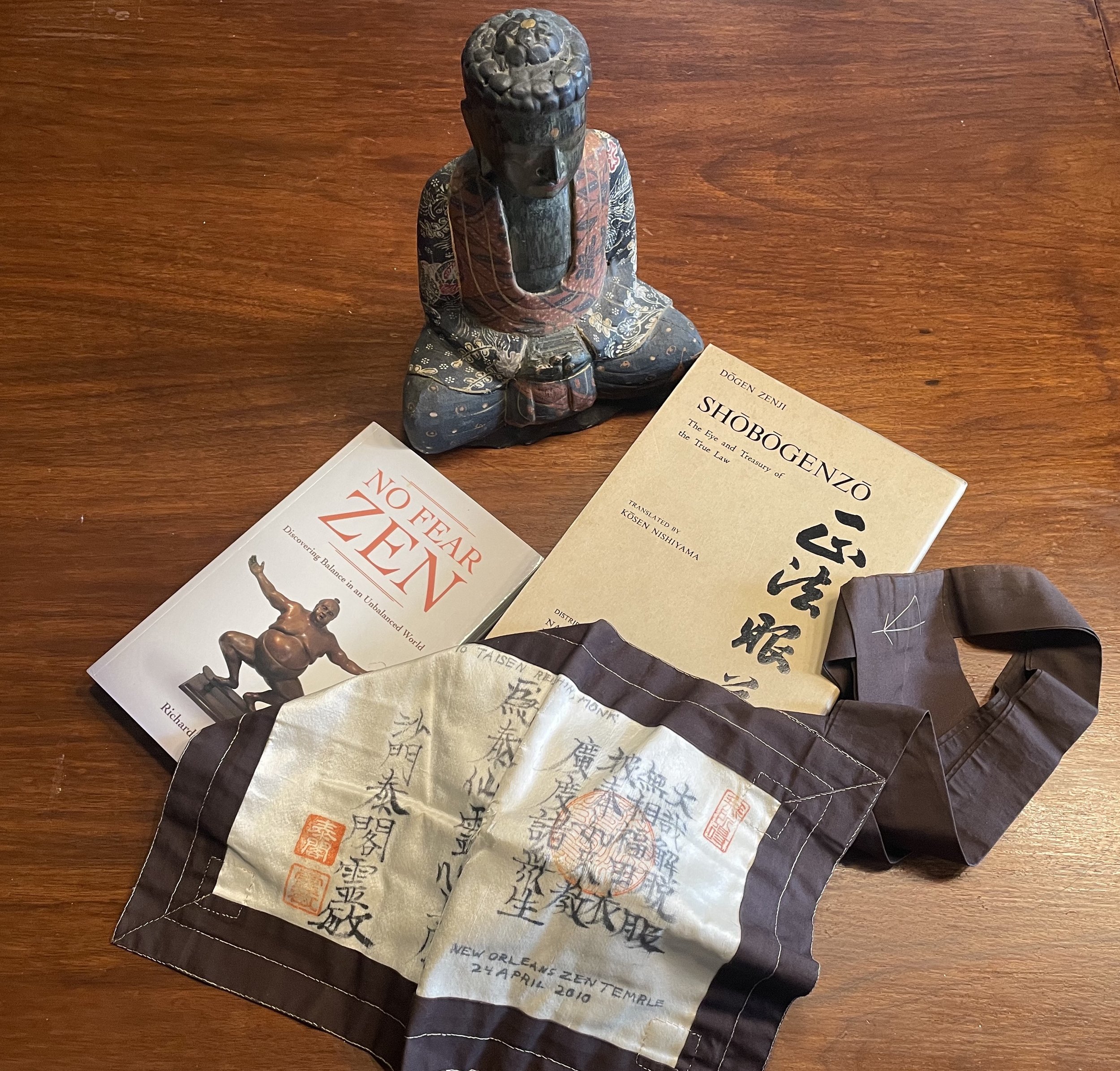
I saw how my own career as a Zen teacher fit those stages. I started practice and took bodhisattva ordination in 2001. From then until 2016, I took monastic ordination, went through the shuso ceremony to become an assistant teacher, which culminated in my book No Fear Zen in 2015 and shiho in 2016. The second stage, the hard work, began when I moved into the Temple and took care of Robert for the next five years until 2021 when he died.
Then began the really hard work of being a truly independent teacher, when things, as they say, got real. No more deferring the responsibilities by relying on the teacher or the teachings. As the great 12th-century Chinese Chan Master, a laywomen, Miaodao said: “You suddenly find that you are a teacher; at that time you have to throw away the teachings and teach.”
One more entry from my journal. My daughter Izzy, who was nine at the time, was attending a very conservative Lutheran school where she was bombarded with hellfire and the Bible. I tried to counteract the propaganda with discussions on the way to and from school. They were telling her all kinds of things that she knew weren’t right because she had a scientific mind even then.
So I said you need to take the Bible just like any other book. And she, without skipping a beat, asked: “fiction or nonfiction?”
The perfect answer. Here she became my teacher, not for the first or last time. She was the master and I the disciple.
This brings me back to my journals. Fiction or nonfiction? I am using them to check facts, but they are actually a mixture of fiction and nonfiction. They never tell me the way things really were. Only my fantasies, my anxieties, lots of anxieties! Fictional and nonfictional. All that stuff was all up in my head. Little successes blown out of proportion, little failures blown out of proportion. Ambitions, regrets, mind stuff, all that mental activity we get caught up in by overthinking instead of thinking not-thinking.
Fiction or nonfiction? Both. Because what is a book? A book is just an exploration of our sense of reality. Like any other book, my journals are an expression of my sense of reality at the time.
I know some of you are thinking of bodhisattva or monastic ordination, so I wanted to let you know what was on my mind because when we consider ordination, sometimes we think too much. Even the night before the ceremony, I remember hoping I wouldn’t make a mistake, wondering what my dharma name was going to be! All these egotistical thoughts. Even doubting whether ordination was right for me. Was I making a mistake?
This mental sparring with yourself doesn’t stop after ordination. Part of my embarrassment was reading how even after I became a monk I obsessed about the very things people say when they leave the practice or get cold feet about ordination. I didn’t like the taste of genmai, I didn’t see the point in all the rituals, why are we chanting in Japanese? All of which shocks me now because I thought I was always pretty down with all that.
But then, the year after monastic ordination, all that doubt, all that wavering, mental slicing and dicing, seemed to get sorted out. After ten years of practice it started not just to make sense up here in the brain but to make sense down here in the hara, and here in the heart-mind, the shin, which is our center and the center of our practice. This heart-mind-felt certainty is sometimes called faith. (I don’t like that word, too much religious baggage, just like with “master-disciple” — even so, when I say teacher, you can assume I also mean master; when I say student, you can assume I mean disciple.) Rather than faith, trust may be a better word. Or confidence in giving yourself over, abandoning yourself to destiny. If you don’t feel destined for the practice, it probably isn’t right for you. But one thing is certain: overthinking undermines confidence, trust, faith.
We should definitely quiz our parents, criticize our teachers, question the Bible, interrogate ourselves, and so forth. That’s what our thinking brains are for. But there are aspects of our existence that can’t be thought through with reason or logic, deduction or induction.
Sitting is not the time or place for questioning with the brain. In zazen we just are. That is an important distinction, but it’s very difficult to get there. Even in zazen when we are “just sitting,” just being can be difficult because we are thinking about the pain in our knees, the temperature in the dojo, what we’re having for lunch, all kinds of idiotic trivia. How’s my posture? Am I thinking too much, too little? Am I fantasizing? Am I romanticizing? All the stuff that goes through and then out of your constantly thinking brain.
But then there are those moments of clarity. There are moments of gratitude. There is just being there, as though you are just sitting there, which is the truth of the matter. I’m just sitting here, how wonderful! And that’s enough. And everything is cool. For a minute, before you go back to worrying again. But it is important to remember those moments of insight when everything was cool just as it is. At those moments there is no imperfection, no suffering, no dukkha.
Life is going to present itself as imperfect to us most of the time. These moments of perfection may feel like satori (or epiphanies, or some other inadequate word, so let’s not call them that). Those moments are not special, they are just us getting back to our natural state. Not fiction, not nonfiction. Just the book we are writing with our life.