No-Self Portraiture

In zazen we are all nude models for ourselves.

Concentrate! Stretch the backbone. Head presses the sky. When we say “concentrate,” this has nothing to do with thinking. It is not like studying for an exam. It is more like making a fist, except that it is effortless. It is more like a yawn or a sneeze or laughter: whole-hearted, spontaneous, yet silent and invisible. Mind is concentrated in the body like tea in hot water, infused.

Last night I was reading Notes of a Nude Model. The author talks about the amateurs, those models who don’t last, the ones who are self-conscious, who have an inflated sense of themselves, modesty or shame or pride. Or the lazy ones who think sitting for an artist is just sitting and relaxing on the dais and collecting a check. No, real models work up a sweat by just sitting, just like bodhisattvas in the dojo. 

During zazen, like modeling, although we just sit, we never relax into our posture. In shikantaza we constantly stretch the backbone, head pressing the sky. Like an artist’s model, we hold the pose like a pro. We don’t fidget; we are not here to make ourselves comfortable, to self-soothe, to suck our thumbs. 

We are here to concentrate. To strip ourselves naked and to observe the beauties and blemishes, unmoving and unmoved, without pride or prejudice. Zazen is neither analysis nor appreciation. It is observation but without a mirror and without an artist to reflect or interpret us. We are a mirror of ourselves, our own artists, our own interpreters, like empty plaster casts on a balcony aware of the world around us.

Reading Notes of a Nude Model I was reminded of when I lived in London and sat for an artist friend of mine in his freezing studio in Hackney back in 1980-81. The cold never affected me until I tried to move. After a couple of hours of “just sitting,” I recall how on the bus ride home to Victoria I would feel emptied out but exhilarated too. I would catch a glimpse of myself in the reflections of the windows with the London cityscape in the background and hardly recognize that person, my so-called self: who was that “self” anyway? 

Twenty years later, when I began to come to the dojo and strip myself naked morning after morning, I would recognize that feeling of being emptied out after zazen. It was as though I was sitting for my portrait, except that it was a no-self portrait. In zazen we are all nude models for ourselves. We sit like pros, emptied out and sweating. 

— Richard Collins

ZEN PROGRESS

Everyone seems to be interested in their “progress” in Zen practice. Whether we have been practicing for two weeks or twenty years, we sometimes wonder whether we’ve made any progress. This occurs to us even when we know that there is no such thing as progress in Zen practice. The only progress is realizing that progress is illusory.

Unlike in the martial arts, we don’t have a system of grades and rewards in Zen. We don’t have different colored belts to indicate where one is in their practice, to mark their achievements. No competitions to build up or confirm our confidence, or to tear it down. Of course some people insist on seeing ordination as a mark of distinction, like graduation from high school or college — it’s more like graduation from kindergarten. 

It’s a familiar pattern: strong practice until ordination, then a slacking off, while they savor the view from the height of their little dunghill. This is a mistake. Bodhisattva ordination, monastic ordination, the shuso ceremony, even shiho, these are all aspirational; they are not graduations into some higher rank, some exalted realm of the enlightened. One only takes on at each stage the added responsibilities of continued practice with a greater realization of one’s incapacity. 

There is only one belt in which to wrap yourself in Zen, and that is the black belt of your own Death. Congratulations! Until then, though, we are all works “in progress.”

In Buddhism, however, death is symbolized by white (the color of all colors) instead of black (the color of no color). The white belt in martial arts dojos is the color of the beginner.

So we go back to the cushion each time as a beginner, always to confront the same question: what to do now in this moment, how to live life here and now. The progress of yesterday is past, the achievements of yesterday have expired. Yes, we have made some improvements, we have perhaps dropped some delusions. But just as with the dharma gates that we penetrate (there is always another and then another to open), delusions are endless: we vow to drop them all. 

Perhaps we have dropped the illusion of ambition — either because we have achieved our goal or failed to achieve it — but we have not dropped the delusion of hope. We have dropped the illusion of insecurity, only to replace it with the delusion of security. We exchange regrets for new fears, desires for new disillusionments, and so on. 

Is this progress? Maybe. But we still go back to the same unanswerable question: how to meet this moment here and now.

Do we make progress? Robert used to speak of the “wisdom” that arises from Zen practice, a spontaneous, natural, automatic, and unconscious alignment with the cosmos, the order of things, the Dao, the Way. What sort of wisdom do we achieve? Can we call it progress? 

From time to time in our practice we realize that something in our lives has changed, changed for the better — i.e., it has “progressed” — but this realization usually happens only after the fact. Satori can be —and usually is — very subtle, more like an evolution than a revelation. We look back on a difficult time like an expanse of water that we have somehow walked across and wonder: how did I get through that?

But we must not expect to be rewarded even for our unconscious miracles.

When the Emperor Wu asked Bodhidharma about what merit he had achieved, Bodhidharma answered: “No merit. Vast emptiness.” When we can look upon our progress and say, sincerely, “no merit, vast emptiness,” then maybe we have made some Zen progress.

— Richard Collins

Gary Larson

the oak tree in the garden and the four great vows

You might hear from time to time the koan, “Why did Bodhidharma come from the West?” The answer given is something like, “The oak tree in the garden.” 

When Buddhism came to China, it became more grounded in the phenomenal world, less airy. Not so many floating devas as Buddhism had in India, as a sort of hangover from the polytheism or henotheism of Hinduism. As Buddhism collided with Taoism, it became more realistic, more connected to nature, firmly planted in the here and now. It became Chan, and eventually Zen.

They are still up there, of course, the floating spirits. Take a look at the wonderful folk novel, The Journey to the West, or any martial arts movie, like the one I saw this week, The Sorcerer and the White Snake. These are full of magical transformations, transformations that these fantasies promise come from practice, defying gravity, logic, and the laws of biology and physics. It is not so easy to wean people of their addiction to the supernatural. We are children in that way.

Zen brings us back down to earth. 

Bodhidharma is the face we give to this crux in the evolution of Zen. Bodhidharma as he was known in India, or Tamo as he became known in China, or Daruma in Japan. We say he came from India, sat for nine years in a cave at Shaolin, cut off his eyelids from which sprang tea leaves, and invented kung fu. This recognizable human figure is someone we can identify with. But of course changing centuries of belief took much longer than what could be done by just one person, it is a much more complicated process, just as changing the narrow path of Theravada or Hinayana Buddhism into Mahayana Buddhism, the narrow path into the broad path, was a much more complicated process than the effect of just one lifetime.

Yet in our Zen practice, this is exactly what is expected of us, changing our narrow path for the broad path, the little mountain getaway for the peakless mountain of Zen practice, the private stream for the shoreless river. 

Fulfilling the Four Great Vows of the Bodhisattva path cannot be the work of a day, or a lifetime. Yet we can fulfill these vows every day if we don’t think of them in an abstract way but in a concrete, down-to-earth way

These vows may seem quite theoretical. But just as Bodhidharma planted Zen in China at Shaolin, we need to plant the bodhisattva vows in our own reality here in New Orleans, or wherever we happen to be.

The first great vow is – Shujo muhen seigan do – Beings however many they are, and they are innumerable, I vow to save them all. 

Not only is that impossible, it doesn’t make a lot of sense. So it is much better to plant that as an oak tree in your own garden by finding a concrete equivalent in your life that makes sense. I am not talking about trees, of course. 

What does it mean to save all beings? How can you do that? Simply by taking care of the things around you, whatever is in your power. Not just those things that are your responsibility legally or officially, but everything that you come in contact with, everything that your being affects. The zafu you’re sitting on, the clothing you wear, how you drive in the street, your pets, your family, your job, This is what it means to save all beings, Not to go around preaching the gospel of Buddhism or any other religion.

The second great vow is about bonno. Bonno mujin seigan dan – Illusions, however many they are, and they are endless, I vow to drop them all. 

Bonno can be interpreted in many ways. Illusions, delusions, desires, problems, issues. But you must identify your own bonno, your own issues, your own oak tree in that sense. Your anxieties, your obsessions, your betes noires. What are the issues that you are going to drop? Don’t worry about everybody else’s. 

Of course taking care of all of the beings that are near you might help to ease your anxiety or your obsessions, whatever your bonno happen to be. 

The third great vow says that dharma gates – homon muryo seigan gaku – however many they are, and they are endless, I vow to penetrate them all. 

Dharma means many things. It means the order of things, the law, reality, the teachings, your own path or profession. Dharma is what unfolds; dharma is what falls into place. And the gates are a nice metaphor for the opening up of reality, or opportunity, or realizations, or clarities, epiphanies, satori. 

Opening dharma gates – eliminating ignorance – can be very helpful in getting rid of your bonno born of the three poisons – anger, greed, and ignorance – very useful too in saving all beings.

But make it your own satori, not someone else’s. When a boy held up his finger to imitate Gutei’s silent answer to just about any question that he was asked, Gutei cut it off because the boy’s answer wasn’t his own oak tree.

The fourth vow has to do with the Buddha Way – butsudo mujo seigan jo – however long it is, I vow to follow through, and it is endless. 

Here again, you have to discover what the Buddha way is, not from scripture, not from the sutras, not from what I’m talking about, but from your own experience, your own life story. Zazen: this is one Buddha Way, one proven path. But you can’t observe zazen, you can’t hold up your finger in imitation of a teacher. You have to do it yourself. You are the oak tree in the garden, firmly rooted in the posture of zazen.

But finding your Buddha Way is essential to entering dharma gates, helpful in dropping your bonno, and useful in helping all beings. This is why we put so much emphasis on zazen. It is the beginning of the path, but it is also the end. It is the One Great Vow that includes all the others, naturally, automatically, unconsciously.

— Richard Collins

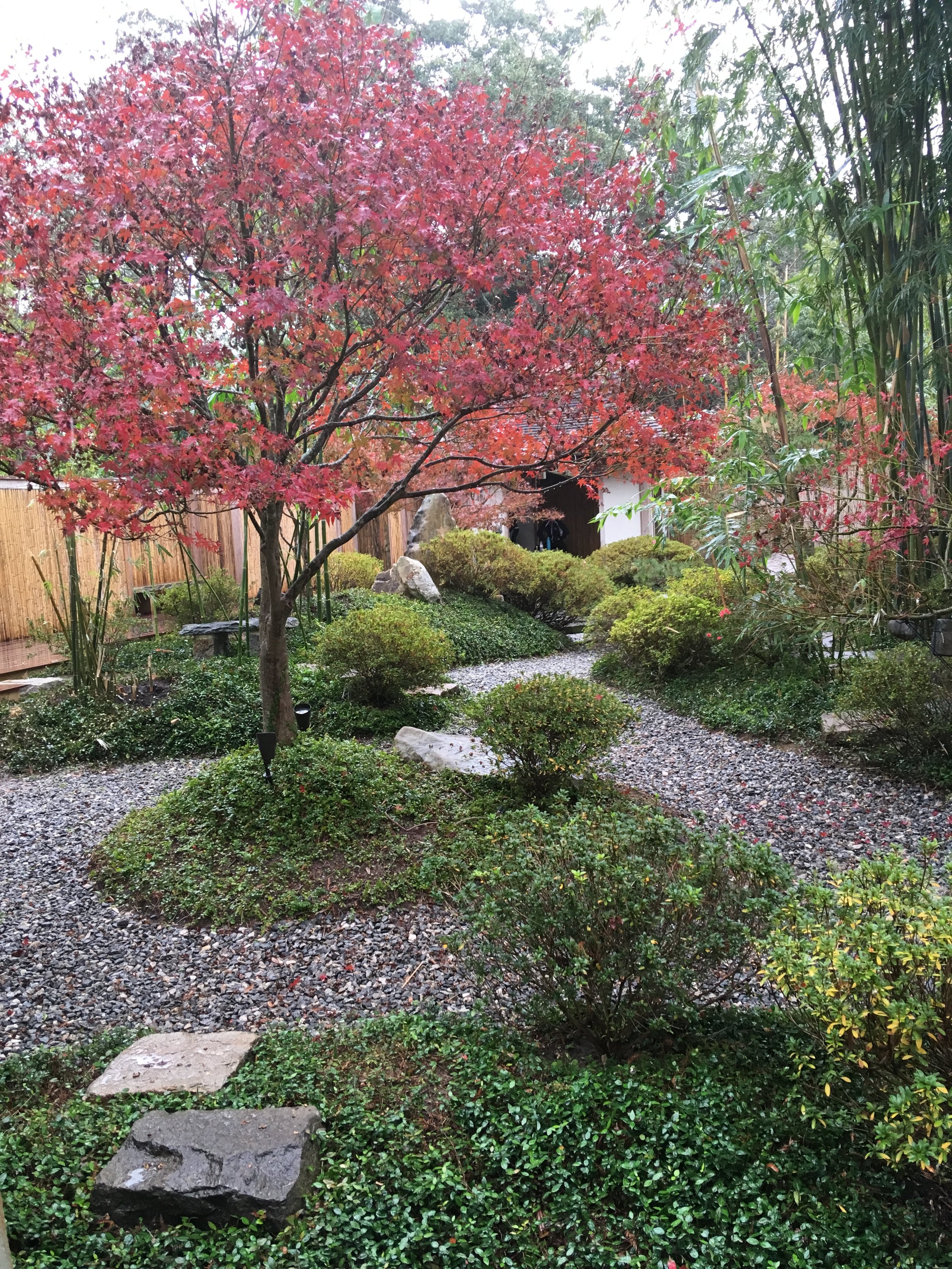
Yakumo Nihon Teien Japanese Garden, New Orleans City Park

ZEN IS NOT A BOOK CLUB

Yesterday I got entangled in one of those online Zen discussion groups. I know better, but I have an incurable urge to be helpful. 

Someone asked a virtual dojo etiquette question that went something like this. “Is it rude to skip zazen and ceremony and only tune in for the dharma talk?”

Everyone seemed to be falling over themselves to be inclusive and welcoming and tolerant and nice and, I suppose, “Buddhist,” by saying that it wasn’t rude at all, that “in these times” it was certainly okay, that they were just happy she was “getting the dharma,” and so on.

I suggested that maybe we were not the ones she should be asking, since not all online groups had the same etiquette. I wrote, “You should ask them.” 

It seemed to me that she already suspected that it was rude, or else the question would not have occurred to her. Instead, she seemed to be congratulating herself by announcing that she was being sensitive to their feelings even if she was not respecting them, while at the same time asking the world at large for our permission for her to be rude even though it was really none of our business.

The moderator asked what “my” answer would be. My answer was needlessly nuanced. I thought it would depend on whether this was a one-time deal or if it happened all the time. Was there a reason for her skipping zazen and ceremony, or was it just her preference? Was she in another time zone? Was there some Daylight Saving Time confusion? If not, then I would wonder whether she was only interested in the discussion of ideas instead of in the practice. If we followed the analogy of in-person zazen, was it rude to come in only for the discussion afterward? It would, at the very least, seem odd. What if someone, for example, came only for ceremony?

The online dojo, of course, has “in these times” caused us to relax some of our etiquette, but that is no reason to abandon it. Dojo etiquette is usually based on two principles. First, it keeps us from disturbing the others we practice with. When you enter a virtual dojo late, there are no creaking steps or slamming doors. But dojo etiquette is also for the development of our own self-discipline. Being late to the virtual dojo does not speak well of someone’s discipline.

Then there is the question of picking and choosing the elements of our practice. As it says in the Shinjinmei, the Way is not easy, not difficult, if you just don't choose. While tuning in late virtually does not have the same disruptive effect, it would seem to have the same intention of picking and choosing your own preferences. But Zen practice is not about you.

The whole issue reminded me of book clubs. Skipping zazen and ceremony and arriving in time for the dharma talk seems a bit like not reading your book club’s selection but coming for the wine and cheese anyway. You want to enjoy the discussion and fellowship and refreshments, but are those really worth the effort of actually reading the book? I know it’s often done, but Zen is not a book club.

Zen practice consists of the three treasures: Buddha, Dharma, and Sangha. Or, to put those in concrete terms: Zazen, Teachings, and Fellowship. To skip zazen and ceremony and choose only the talk is to throw out the Buddha and keep the Dharma and Sangha.

I wondered why no one in our sangha ever tunes in just for the dharma talk. Is it because we are too strict, not welcoming enough? Or maybe it is because we don’t really have dharma talks like other sanghas. Our dharma talks consist of kusen (spontaneous oral teaching during zazen) and mondo (question and answer discussion after the closing ceremony). In our lineage, the dharma talk as such (teisho, a sort of lecture or sermon outside of zazen) does not really exist or is at least rare.

So if this person had missed zazen, she would have missed the dharma talk.

I was struck anew by the unique nature and value of kusen, which is somewhat peculiar to the Deshimaru lineage. I realized that maybe the kusen’s power is that it integrates all three treasures at once: Buddha, because kusen is delivered during zazen; Dharma, because it is teaching during zazen; and Sangha, because we are all hearing it together in the present moment whether virtually or in person during zazen.

The teisho gives the impression that it can exist without zazen, that it is somehow different from zazen, and thus inviting comparison with zazen, with the result that some people think it is more valuable. If the choice is between zazen and teaching, they might say, “I didn’t come here to sit and waste time staring at the wall.” 

Just don’t choose. 

We used to have a fellow in our sangha who was gung-ho about Zen, completely focused on satori and enlightenment. One day during sesshin he came up to me and complained about samu, work practice. “I’m not here to scrub toilets,” he said, “it interrupts my practice.” I asked if he thought samu was different from zazen. He just looked at me like I was crazy, packed up his bag, and was gone. Now he’s a physical trainer at a gym. I don’t know if he found satori, but he seems to have found his work practice, and that’s good. Zen is not for everyone. It is not a gym, and it’s not a book club. 

— Richard Collins

Is zazen different than cleaning the toilet?

Memorial for Robert Livingston, 9 January 2022

Taikaku Reibin Zenji (28 January 1933 - 2 January 2021)

Today we celebrate the anniversary of the death of the founder of our Temple, the first Abbot of Muhozan Kosenji, Peakless Mountain Shoreless River Temple, Robert Livingston, Taikaku Reibin Zenji. 

It has been one year and seven days since the morning of January 2nd, 2021, when he entered nirvana.

What is nirvana? Many people mistakenly think of nirvana as bliss. But it really means “extinguishment.” The flame is not only out, it is out cold. All that was the Robert we knew has entered the Void, or I should say “re-entered” the Void. The light is not just gone, but any notion of light and dark ever having been has evaporated. Life is no more. Thus suffering is no more. Discontent is no more. Longing is no more. Anxiety is no more. No more is no more. 

And when one is old and has lived a full life after 87 years, this extinguishment is not such a bad thing. Robert would sometimes lament getting old, but he would more often say that it was better than the alternative. But who knows? As Robert always said, “Come to zazen, climb into your coffin. Leave zazen, climb out of your coffin. What’s the difference? Nothing to fear.” Perhaps zazen gives us a glimpse of nirvana. A glimpse of what it is like when fear and desire, when complication and simplification, when the drama and slapstick comedy of our lives are no more.

Yet Robert himself is not extinguished. He lives on in us, in our practice, in this temple, and in our zazen. Now we are his eyes and ears and nose and mouth, his straight spine and his head pressing the sky. Just as the Buddha told his disciples that they were his flesh, his bones, his marrow.

Now we celebrate the anniversary of Robert’s passing with this sesshin. I often imagine him gazing out on our aching backs near the end of sesshin as though we were a range of mountains, and then, at the party afterwards, gazing out at us, with amusement and satisfaction, and perhaps a little pride. 

He would be happy, I think, to look out at you as I am now, sturdy in your zazen. He would be happy, too, to know that we will have a new bodhisattva and a new monk today. He always took special joy in ordinations, and I think he would be especially pleased at these two new members of the sangha today. 

After all, what more could he possibly ask for in the way of eternal life than for these two to be part of this great lineage, the lineage of Somon Kodo and Mokudo Taisen and Taikaku Reibin?

To honor this lineage, and the anniversary of Robert’s death, I invite everyone during this morning’s Hannya Shingyo, to offer shoko just as I do every day at the altar, by bowing at the head of the tatami, stepping to the left, advancing to the altar, stepping to the right, bowing, taking a pinch of shoko incense and dropping it on the charcoal ember, before returning to your zafu. We will repeat the Hannya Shingyo until everyone has had a chance to offer shoko.

By offering shoko to Robert’s ashes — ashes to ashes — we pay respect to his life and his life’s work, and to the perpetuation of his life in our practice. 

There were times when we heard Deshimaru in Robert’s voice when he chanted the Hannya Shingyo. And there are times when I hear Robert’s voice in mine while chanting. There is nothing supernatural or superstitious or sentimental in this. It is just the way it is.

Please concentrate on your chant today with a focus on your hara. There’s a Buddha in our belly. Let it out. It might be Robert.

— Richard Collins

Robert Livingston, circa 1978

Ten Tips for Reading Dogen

Carve these words on your skin, flesh, bones, and marrow; on your body, mind, and environs; on emptiness and on form. They are already carved on trees and rocks, on fields and villages.

— Dogen, Sansuikyo (trans. Kazuaki Tanahashi, et al.)

*****

Dipping for the first time into Dogen’s Shobogenzo can be a little like a reader’s first encounters with James Joyce. Although there are some works that seem fairly accessible, like Dubliners or A Portrait of the Artist as a Young Man, others are either a delightful if difficult surprise (Ulysses) or an impenetrable mystery (Finnegans Wake). 

Recently someone asked after zazen about how to read Dogen and several suggestions emerged. From “read very slowly, just a phrase at a time” to “let it wash over you like a tsunami.”

Is there any wrong way to read Dogen? Not really. But here are some suggestions that I have found helpful in navigating his often opaque and profoundly moving prose.

1. Start with Fukenzazengi. 

Following these brief instructions for practicing zazen (and then practicing zazen) is the best preparation for reading Dogen. 

2. Remember the context.

Remember that Dogen is mostly talking to monks in a monastic setting. So not everything applies to you here and now. He can be very prescriptive about very personal activities, like going to the toilet. But you don’t have to take that for gospel, just as you would not want to take all Gospel for gospel. Approach his medieval exhortations with a granary of salt.

3. Read closely, then step away.

There is nothing wrong with close reading, careful reading, scholarly reading that brings all the resources of criticism and philology and philosophy to bear. Kodo Sawaki said that all the commentaries on the sutras are but a footnote to zazen. But footnotes can be helpful. Still, there are limitations imposed on even the most talented linguists by Dogen’s syntax, semantics, and grammar, which are inaccessible to us who are not fluent in thirteenth-century Japanese, as well as to those who are.

4. Triangulate your translations.

Since most of us will not be reading Shobogenzo in the original Japanese, we should not get too attached to words and phrases, even when they sound lovely and touch us deeply. I always try to read anything by Dogen in at least three translations: the most accessible, by Kazuaki Tanahashi and others; the most literal, by Gudo Nishijima and Chodo Cross; and the most explanatory, by Kosen Nishiyama. Since Dogen’s meaning is just beyond the grasp of words (in any language), we should not be too insistent on interpretations or words (in any language).

5. Read with your gut.

My teacher used to say, “Think with the body, act with the brain.” Like hishiryo consciousness, which arises during zazen, called at times “thinking not-thinking,” our experience of Dogen’s texts should not incorporate only the thinking brain (reason, logic, scholarship and such) but also the not-thinking gut (or hara, where spontaneous wisdom resides). This process we might call “reading not-reading.”

6. Consider his fascicles as tapas or mezes, not a feast.

Since we are reading with our gut, we need to remember that one can easily overdose on Dogen. His food for thought is rich and can cause indigestion if taken in large quantities. It does no good to binge and purge on Being-Time. I once had a student who wanted to cover two or three fascicles in a sitting; he soon became a Catholic instead.

7. Back and forth.

Dogen’s syntax is not our syntax. Just as form becomes emptiness and emptiness becomes form, so Dogen’s subjects become predicates and predicates become subjects. So while we can hear “to study the self is to forget the self,” we must also perceive the unheard echo, “to forget the self is to study the self.” Sequence and narrative are our citadels of meaning, but Dogen tears these down because in the dharma there is no north or south (except, evidently, when placing a lavatory: see his toilet training for monks in Senjo). Neither is there forward or backward.

8. Just don’t know.

“I want to understand Dogen” is the eager and admirable intention of the beginner. However, when we give up the search for this chimera of complete understanding, we begin to see how Dogen can help us to understand our own practice, which is a much more helpful result. Dharma gates are innumerable; I vow to penetrate them all. So don’t be afraid to not know when reading Dogen. Like the gateless gates of koans, the wall we face is a mirror as well as a window as well as just a wall. But as Seung Sahn would say, “Just be sure that you don’t know ‘don’t know’!”

9. Allow yourself to be moved emotionally.

Sometimes we bear down so hard on a text with our analytical brains that we forget to be moved by the music and mystery of words (even more magical sometimes in translation). In his Mountains and Waters Sutra (Sansuikyo), Dogen transcends poetry and prose, as well as incantations and allusions, and speaks directly to the psyche. I have been struck dumb by this fascicle without understanding a word of it, yet resonating with its force like a struck drum weeping.

10. End with Fukenzazengi. 

In the end, the only validation of our understanding of Dogen (or our knowing not-knowing what he might have been saying) is our experience of zazen. Take your reading to your zafu, not your zafu to your reading. And enjoy.

— Richard Collins

https://learnjapaneseaz.com/

Zensplainers

Long practice does not necessarily make for strong practice.


Every dojo has one. 

He is the one who has been around for a while, often having practiced at several different dojos, and thinks he knows something because he has put in his time on the cushion. I say “he” because it is almost always a male. Zensplainers suffer from the same malady as mansplainers. 

He is the one who will correct your movements in the dojo, from the moment you step over the raised threshold with the wrong foot until the moment you gassho and bow out forever, saying, “If that guy is what I’ll turn into if I practice Zen for a long time, I’m out of here!”

In the most virulent form, he can become a Zen Nazi, barking and threatening and abusing his authority, although in a good dojo he would never get any real authority. Most Zensplainers are just more like Zen uncles at Thanksgiving, annoyingly avuncular and out of touch with the present reality.

Some Zensplaineres will correct you only about the forms, to which they are terminally attached. Others, however, will also attempt to engage you in sophistic Dharma Combat, even though they have never gone through the formal hossen shiki ceremony to make them a teacher. 

He is particularly compelled to Zensplain to newcomers, although no one is really safe, including the master. The veteran Zensplainer will also offer his unsolicited corrections to anyone younger or “less experienced” than he is, even if that person has been given authority that he has not, especially if that person is a woman. He would willingly usurp their authority if they allow him to be as “helpful” as he would like.

There are at least two problems with Zensplainers. 

First, like mansplainers, they think they are being helpful but really they are only helping their own egos. They are like Charles Johnson’s Herman Wilder, shouting on Echo Mountain: “Herman Wilder is a most enlightened fellow!” 

Second, and again like mansplainers, they are often wrong.

The root of this problem is partly in the ego. These old-timers like to think that they have learned something and can only demonstrate this by instructing others. They want to share, but what they are sharing is outmoded and, worse, wrongheaded. Zensplaining behavior shows that they have learned nothing. If they had, they would sit down and shut up and attend to their own practice, cherishing their beginner’s mind, instead of aspiring to teach.

Long practice does not necessarily make for strong practice. Investing one’s time is no different than investing one’s money. As Bodhidharma told Emperor Bu, who had invested time and money in Zen by building many temples, “NO MERIT! Vast emptiness. Nothing sacred.”

Every dojo has one. 

— Richard Collins

Cartoon by Charles Johnson

Attachments and Obligations

Everything worthwhile in life is a paradox.

I have been reading Ihara Saikaku’s Life of an Amorous Woman. It’s a collection of his koshokubon, or erotic writings, including “The Tale of Seijuro from Himeji, the Town of the Lovely Damsel.” In this story the young man, Seijuro, is living a dissolute life consorting with all eighty-five of the courtesans of his small town. One day he has them all undress together to satisfy his whim to recreate in the flesh the so-called “Isle of Nakedness,” which he has only seen on a Chinese map. When the artfulness of the women’s dress and half-dress is cast off, it becomes clear that they owe their seductive attraction mostly to the artistry of their clothing which conceals in each of them some physical flaw — flaws when revealed in the light of their nakedness dampens the lust in the men. 

There is a lesson to be learned here about how art disguises nature, about appearance and reality, about the illusion of desire, and so on. But that’s nothing new, we know all that — that is not the most interesting part of the story. 

At this point Seijuro’s father bursts in and, disgusted with the scene, disowns his decadent son. Disgraced, the son contemplates suicide and half expects his favorite courtesan, the young Minakawa, to accompany him. Except that she reminds him that it’s the nature of her job to change her affections from one man to another, so it’s sayonara Seijuro. 

There is another, more interesting lesson to be learned here about mujo, impermanence, the transitory nature of desire; that passion is fleeting and fickle, especially in the floating world. And there is a reason the founder of Zen, Daruma, in addition to being a child’s toy in Japan, is associated with prostitutes. But that’s not what I want to talk about, either.

What I want to talk about is why Minakawa says she can’t commit suicide with her favorite lover, Seijuro. She begs off, saying that she has “attachments to the world.” By this she means not only desires and longings for the material and sensual delights (what in a Buddhist context we might normally think of as attachments) but rather something more intangible and compelling — obligations. She may, for example, owe money to the house and madame she belongs to, or there might be other duties that death would make it impossible for her to fulfill once she took that step, much as she might like to accompany Seijuro out of this world. 

This set me to thinking in a new way, or at least in a nuanced way, about attachments — in the Buddhist sense and in my own life — as obligations rather than just longings or desires. Longings and desires are not only easy to contemplate leaving behind, but they can drive us, like Seijuro, to think about ending them by self-destruction — and this escape becomes yet another in the long spiral of seductions. But so long as one has obligations, one cannot honorably absent oneself from the world. That would be the height of selfishness in Tokugawa era society. It is only when disability or dishonor makes it impossible to fulfill one’s obligations that one is not only allowed but sometimes bound to end one’s worldly existence. 

Instead of committing suicide, the eighteen-year-old Seijuro becomes a monk (although not for long). One might say that he leaves the world symbolically. Minakawa, on the other hand, does manage, inexplicably it seems after all her reasonable objections, to kill herself in actuality. Seijuro’s ordination is the less permanent solution to their temporary problem, since he will live to love another day.

Becoming a monk means giving up not only attachments to personal desires, but also to social obligations. This is the meaning of the home-leaving part of our ordination ceremony. Yet there is a tension here, a contradiction, and it is this that I find most interesting. At the same time that monastics leave their worldly obligations behind on one level, yet they pick up other heavier obligations on another level. For what are we bodhisattvas but beings who embrace our obligation to save all beings? We don’t strive to be arhats or lohans, enlightened beings detached from the world, basking in the glow of a premature nirvana. On the contrary, our job is much more nuanced, difficult, and interesting.

Like the young Seijuro, I was once like a floating weed, free and unattached — and often miserable in the unbearable lightness of being, disrobing the world and reveling in revealing its blemishes. The erotic world was all in all for me, my religion, I suppose. The world of shiki — of color, form, sensuality, texture — was all I cared about, that and elegance and intelligence and beauty. It was only when I became a monk — and before that, a bodhisattva — that I became truly engaged and embraced my obligations. It was only then that I finally gave up the seductive idea of suicide and took on the burdens that paradoxically grounded me in a sort of freedom I had never known.

The attachment of obligation saved me. My duty to the temple, my duty to Robert, my teacher, saved me. My duty to my wife and daughters saved me (that was always available but somehow I had always managed to shirk it). My obligation to you, my Zen students, saves me every day.

This is the meaning and value of sangha. It’s not about friendship or fellowship. It’s not about some personal spiritual enlightenment. It’s about the power of the obligation to save all beings. We save each other without even knowing it, without even trying. It’s not about you. It’s not about me. It’s not even about us. Zazen teaches us this without words, without nuance. It’s all about seeing the world in the nakedness of ku, emptiness. No matter how lightly we wear this obligation, it is about the reason to go on. To endure.

The etymology of obligation derives from the Latin, and it has to do with a formal and binding pledge, a pledge that we take in the form of the ordination vows, those four impossible obligations: to save all beings, to drop all illusions, to penetrate all gateless gates, to be buddhas here and now. But it is important to note that we attach ourselves to these vows in the same way that we attach ourselves to water when entering a stream. You have heard me say before: attachment is not a problem, attachment is natural — it’s attachment to attachment that is neurotic. You can no more cling to your vows than you can cling to the waters of the stream: they cling to you, naturally, like Dogen’s fish swimming in the ocean. 

We must take care, then, not to become attached to our attachments, nor obligated to our obligations. Otherwise we become rigid and pious when we should be pliant and lighthearted. Are these contradictions? Yes. Are they paradoxes? Yes. Everything worthwhile in life is a paradox. 

— Richard Collins

A Parade of Courtesans (c. 1690) Hishikawa Moronobu